
7 Email Retention Policy Best Practices "Rules" That Are Actually Myths (And What to Do Instead)
Table of contents
- Why Email Retention Gets So Many Companies Into Trouble
- Myth #1: "All Emails Should Be Retained Forever — It's Safer That Way"
- Myth #2: "Email Retention Is an IT and Legal Problem — Not My Department"
- Myth #3: "Our Email Backup System Covers Our Archiving Requirements"
- Myth #4: "One Retention Schedule Is Enough for All Our Emails"
- Myth #5: "Small Businesses Don't Need a Formal Email Retention Policy"
- Myth #6: "Deleting Old Emails Proactively Is Legally Risky — Better to Leave Them Alone"
- Myth #7: "Once We Set Up Our Archiving System, We're Covered"
- Conclusion: What a Defensible Email Retention Policy Actually Looks Like
Think your company has email retention figured out because IT set up automatic archiving three years ago? I hate to break it to you — that might be the most dangerous assumption in your compliance strategy.
Email retention policy best practices have evolved dramatically. What companies treated as gospel five years ago is now getting them slapped with regulatory fines, sanction orders in litigation, and in some cases, criminal exposure. In this post, I'm going to walk you through the seven most stubborn myths about email retention that I see organizations repeat — and back every single one of them with enforcement data and real case outcomes. By the end, you'll have a clear picture of what a defensible email retention policy actually looks like in 2026.
Why Email Retention Gets So Many Companies Into Trouble
Email is where business happens. Contracts get negotiated, decisions get made, complaints get logged. The average business user sends and receives around 120 emails per day, according to a 2023 Radicati Group report. Multiply that across a 200-person company over five years, and you're sitting on hundreds of millions of messages — most of which your team has no organized system to manage.
That's exactly why email retention myths spread so fast. Everyone knows it's important. Nobody wants to dig into the details. So common-sense-sounding rules get passed down as fact, and organizations build compliance programs on top of them.
Let's break that cycle.
Building trust with your email list starts with clear data policies. If you're ready to create compliant and professional emails, Tabular's html email templates come with built-in best practices for privacy and transparency, so you can focus on retention strategy.
Myth #1: "All Emails Should Be Retained Forever — It's Safer That Way"
Where this came from: The 2002 collapse of Arthur Andersen — where employees were convicted of obstruction of justice partly related to document destruction — sent a shockwave through corporate legal teams. The reaction in many organizations was simple: delete nothing. Ever.
Why it's actually dangerous: Retaining all emails forever isn't a safe harbor. It's a liability generator. Here's what the data shows.
In Zubulake v. UBS Warburg (2003–2004), one of the most cited e-discovery cases in U.S. history, the court established that organizations have a duty to preserve relevant information once litigation is reasonably anticipated — but also that bloated, unmanaged email archives make it nearly impossible to conduct defensible discovery. UBS faced $29.2 million in sanctions, partly because its preservation efforts were chaotic and inconsistent, not because it deleted too much.
More practically: GDPR Article 5(1)(e) explicitly requires that personal data be kept "no longer than is necessary for the purposes for which the personal data are processed." Under GDPR, indefinite retention of emails containing personal data isn't cautious — it's a violation. The UK ICO fined Marriott £18.4 million in 2020 in a case where inadequate data lifecycle management was a contributing factor.
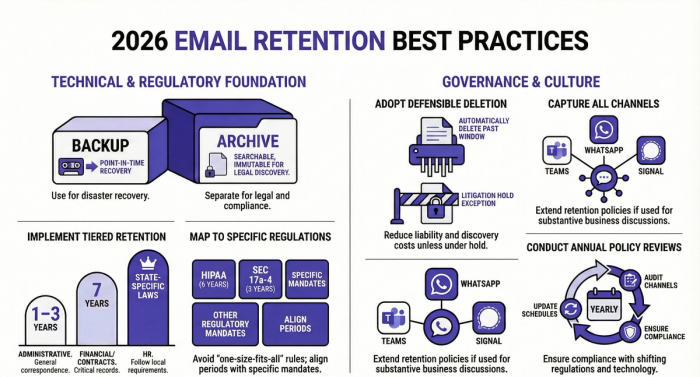
What to do instead: Build a tiered email retention schedule. Most email governance frameworks segment retention into three categories:
- Transactional and administrative emails: 1–3 years
- Contracts, financial communications, and formal business decisions: 7 years (aligned with IRS audit windows and SOX requirements for public companies)
- HR, harassment, and employment-related emails: Follow state law; California requires many employment records for 3–4 years post-termination
Set automatic deletion triggers for emails that have aged past their retention window — unless a litigation hold is active. This is called defensible deletion, and it's the foundation of any mature email records management strategy.
Myth #2: "Email Retention Is an IT and Legal Problem — Not My Department"
Where this came from: Email archiving systems are technical. Legal holds sound like lawyer territory. So over the years, email retention became siloed — IT owns the infrastructure, Legal owns the litigation holds, and everyone else assumes the bases are covered.
Why it's a myth: When the SEC fined 16 major financial firms a combined $1.1 billion in 2022 for employees using personal devices and unauthorized messaging apps for business communication, the core failure wasn't a legal or IT failure. It was a cultural one. Employees at Morgan Stanley, Goldman Sachs, Citigroup, and others were routinely conducting substantive business discussions via WhatsApp and personal email — outside any retention system — because retention policy had never been made their problem.
The SEC made clear in its findings that firms must train employees on retention obligations, not just build systems. JPMorgan was fined $125 million. Bank of America, $200 million. These weren't small firms with weak compliance infrastructure. They had sophisticated legal and IT teams. What they lacked was company-wide ownership of retention obligations.
What to do instead: Email retention compliance should be embedded into onboarding, annual compliance training, and AUP (Acceptable Use Policy) agreements. HR, Finance, Sales, and Customer Success teams all generate email records with distinct retention requirements. Each department head should understand which email categories their team generates and what the corresponding retention timelines are.
A corporate email retention policy is only as strong as the least informed person sending email on your behalf.
Myth #3: "Our Email Backup System Covers Our Archiving Requirements"
Where this came from: Backup and archiving both store copies of emails. To someone who isn't steeped in the technical distinction, they sound interchangeable.
Why this will cost you: Backups and archives serve completely different functions, and confusing them has destroyed cases in court.
Email backups are point-in-time snapshots taken for disaster recovery. They capture the entire system at a moment in time, they're typically overwritten on a rolling cycle (weekly, monthly), and they're not indexed for search. Try to retrieve a specific email thread from a backup and you'll need to restore the entire backup to access it — a process that's slow, expensive, and sometimes technically impossible for specific messages.
Email archives, by contrast, are immutable, searchable repositories that capture every message in real time as it's sent or received. They're built for e-discovery, compliance audits, and legal holds.
In Pension Committee of the University of Montreal Pension Plan v. Banc of America Securities (2010), Judge Shira Scheindlin found that relying on backups instead of proper archiving systems constituted gross negligence. Several plaintiffs were sanctioned and faced adverse inference instructions — meaning the jury was told to assume the missing data would have been unfavorable to them.
What to do instead: Implement a dedicated email archiving solution separate from your backup infrastructure. Major platforms — including Microsoft 365's built-in Compliance Center and Google Vault — offer archiving features that create tamper-evident, indexed copies of all email. Third-party tools like Mimecast, Proofpoint Essentials, and Barracuda Message Archiver provide additional compliance controls, including jurisdiction-specific retention rule sets.
Your backup schedule protects operations. Your archive protects your legal position. You need both.
Myth #4: "One Retention Schedule Is Enough for All Our Emails"
Where this came from: It's simple. One rule, everyone follows it. Seven years for everything — that's the number most compliance teams land on because it covers the IRS window, and it feels safe.
Why one-size-fits-all fails: Different types of email records fall under entirely different regulatory frameworks, and applying a single retention period creates gaps in both directions — over-retaining some records and prematurely deleting others.
Consider the landscape a mid-sized U.S. company actually operates in:
- HIPAA (healthcare): Covered entities must retain documentation of their privacy policies for six years from creation or last effective date. Patient-related email communications may need to be retained as part of the medical record — typically six years under federal law, longer in some states.
- SEC Rule 17a-4 (financial services): Broker-dealers must retain business-related emails for three years, with the first two years in an accessible location.
- FINRA Rule 4511: Requires member firms to preserve books and records for at least six years.
- CCPA / GDPR: Both impose data minimization requirements, meaning emails containing personal data should not be retained beyond business necessity — which may be shorter than your default seven-year window.
- State employment law: Many states require employment-related records — including email communications about hiring, termination, discipline, or accommodation requests — for three to four years post-event.
What to do instead: Build a records retention schedule that maps email categories to the specific regulations governing your industry and geography. Work with outside counsel to identify which regulatory frameworks apply to your business. Then configure your email archiving platform to apply different retention labels to different email types — most enterprise archiving tools support policy-based tagging and classification.
Myth #5: "Small Businesses Don't Need a Formal Email Retention Policy"
Where this came from: Compliance frameworks like SOX and SEC 17a-4 are explicitly tied to company size or type. Many small business owners reasonably conclude that formal email governance is a large-company concern.
Why small businesses aren't actually safe: The majority of email retention laws don't include a small business carve-out. HIPAA applies to any covered entity regardless of size. GDPR applies if you process the personal data of EU residents. IRS audit risk doesn't disappear for a 10-person firm. And critically, employment discrimination claims — which frequently turn on email evidence — can hit a two-person startup just as hard as a Fortune 500.
The U.S. Equal Employment Opportunity Commission (EEOC) requires employers to retain all personnel and employment records, including electronic communications, for at least one year from the date of creation. For companies with 100+ employees, OSHA's recordkeeping rules layer on additional requirements. Neither has revenue thresholds.
What to do instead: Small businesses should implement a lightweight but documented email retention policy. It doesn't need to be a 50-page document. At minimum it should cover: which email categories you're retaining and for how long, where those emails are stored, who is responsible for managing holds, and what your deletion process looks like. Google Workspace Business Starter and Microsoft 365 Business Basic both include basic archiving capabilities at entry-level price points.
A simple, documented policy you actually follow is worth more than a sophisticated one that exists only on paper.
Myth #6: "Deleting Old Emails Proactively Is Legally Risky — Better to Leave Them Alone"
Where this came from: See Myth #1. The Arthur Andersen fallout created a culture of document hoarding. People assumed that proactive deletion, even of legitimately expired records, looked suspicious.
The data says otherwise: Courts have consistently held that routine, good-faith deletion of records pursuant to a documented retention policy is not spoliation — even if litigation later arises involving those records. What triggers spoliation sanctions is deletion after the "litigation hold trigger" — the point at which you knew or reasonably should have known litigation was coming.
In fact, the 2015 amendments to the Federal Rules of Civil Procedure (Rule 37(e)) were specifically designed to clarify this. Sanctions for loss of electronically stored information now require a court finding that the party "failed to take reasonable steps to preserve" data and that the failure caused prejudice. Good-faith operation of a documented retention policy — including scheduled deletion — is a recognized defense.
Keeping emails beyond their retention period doesn't protect you. It creates additional discoverable material, increases storage costs, and can actively harm you in litigation if those old emails contain unfavorable content you were under no legal obligation to keep.
What to do instead: Implement defensible deletion as a formal process. This means: operating under a written, approved retention schedule; triggering automatic deletion at the end of each retention period; maintaining an auditable record of your deletion processes; and implementing litigation hold procedures that suspend scheduled deletion for relevant custodians the moment litigation is reasonably anticipated.
The goal isn't to delete evidence. It's to demonstrate that your organization manages records consistently and in good faith.
Myth #7: "Once We Set Up Our Archiving System, We're Covered"
Where this came from: Email archiving is sold — not unreasonably — as a compliance solution. Set it up, configure the rules, and let it run. That framing creates the impression that email retention is a one-time infrastructure problem.
Why "set it and forget it" breaks down: Regulations change. Your business changes. And the technical landscape shifts. An archiving configuration that was compliant in 2021 may have meaningful gaps today.
The SEC's $1.1 billion enforcement action in 2022 against major financial institutions wasn't about firms that had no archiving systems. Morgan Stanley, Goldman Sachs, and their peers had archiving infrastructure. The problem was that business communication had migrated to channels — WhatsApp, Signal, personal email — that their archiving systems weren't configured to capture. The firms' policies hadn't kept pace with how their employees actually worked.
Similarly, when Microsoft 365 introduced Teams as a primary communication channel during the COVID-19 pandemic, many organizations found their email archiving policies didn't extend to Teams messages — which, under many regulatory frameworks, are subject to the same retention rules as email.
What to do instead: Build a retention policy review cycle into your compliance calendar — at minimum annually. During each review: audit whether your archiving systems capture all channels where business communication now occurs, check whether any applicable regulations have changed, verify that your retention schedules still reflect your current business activities, and test your legal hold and e-discovery workflows with a mock exercise.
Email compliance archiving isn't a project with a finish line. It's an ongoing program.
Conclusion: What a Defensible Email Retention Policy Actually Looks Like
There you have it — seven myths that are actively creating compliance exposure for businesses that believe they've got email retention figured out. The most dangerous one, in my view, is still Myth #1: the assumption that keeping everything forever is the safe play. It isn't. It's a GDPR violation, a storage cost spiral, and an e-discovery nightmare bundled into one.
As you saw throughout each of these examples, the firms and organizations that end up in front of regulators and courts aren't always the ones who deleted too much. Often they're the ones who had no coherent system at all — no documented schedule, no training, no governance, no regular review.
Email retention policy best practices in 2026 come down to four things: know which regulations apply to your specific industry and geography; build a tiered retention schedule that maps email categories to those requirements; implement archiving — not just backup — that captures every channel where business happens; and review your policy annually.
Now I want to hear from you: which of these myths was most surprising? And which one do you think is most common in your industry? Drop it in the comments.
Sources: Zubulake v. UBS Warburg, 229 F.R.D. 422 (S.D.N.Y. 2004) SEC Press Release: SEC Charges 16 Wall Street Firms with Widespread Recordkeeping Failures, Sept. 27, 2022 Pension Committee of the University of Montreal Pension Plan v. Banc of America Securities, 685 F. Supp. 2d 456 (S.D.N.Y. 2010) GDPR Article 5(1)(e), Regulation (EU) 2016/679 Federal Rules of Civil Procedure, Rule 37(e), as amended Dec. 1, 2015 Radicati Group: Email Statistics Report, 2023–2027 EEOC Regulations: 29 CFR § 1602.14