
How to Write a Resignation Email: 10 Templates & Best Practices
Leaving a job is stressful enough without having to worry about getting the email wrong. But a poorly worded resignation — too abrupt, too emotional, or too vague — can leave a bad impression at exactly the moment you need your manager to speak well of you. One email. Permanent record.
The problem is that most people have never written one before. When the moment comes, they either keep it so brief it reads as cold and dismissive, or they overexplain — sharing grievances, listing reasons, or writing what amounts to a confessional. Neither lands well.
A resignation email doesn't need to be complicated. It needs to be professional, clear, and short. Get those three things right and you leave on good terms, protect your reference, and move on cleanly.
What is a resignation email template?
A resignation email template is a pre-written message you can adapt to formally notify your employer that you're leaving. A strong one covers your last working day, a brief thank you, and an offer to support the handover — nothing more.
Below, you'll find 10 ready-to-use resignation email templates covering the most common situations: standard notice, short notice, immediate resignation, long tenure, toxic workplaces, and more. Each one is professional, easy to personalize, and designed to help you leave on the right note.
What to include in a resignation email
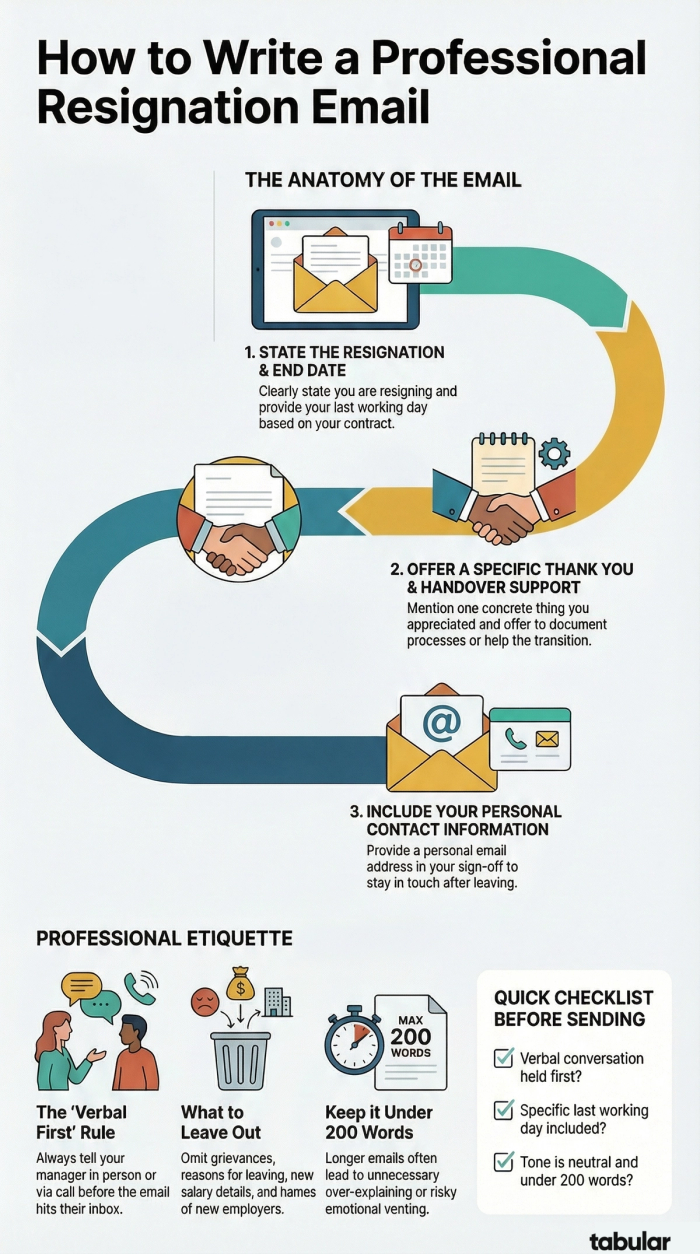
Every resignation email — regardless of your situation, industry, or how long you've been there — should contain five things:
- A clear subject line. Keep it simple: "Resignation – [Your name]" or "Notice of resignation – [Your name, Your role]". This isn't the place for creativity.
- Your resignation and last working day. State clearly that you're resigning and give a specific date. Check your contract before you do — don't assume two weeks is correct. Some roles require four, six, or even twelve weeks.
- A genuine thank you. Brief, specific, and forward-looking. One sentence naming something concrete is far more effective than two paragraphs of generic praise. It doesn't need to be effusive — it needs to be real.
- An offer to help with the handover. Mention that you're happy to complete current work, document your processes, or support the transition in whatever way is most useful. This protects your reference and demonstrates professionalism.
- Your personal email address. Include it in your sign-off so people can stay in touch after you leave the company system.
What to leave out is equally important: reasons for leaving, grievances, feedback about colleagues or management, emotional language, and any mention of your new employer or salary. None of it belongs in this email.
The 10 resignation email templates
Use these templates as a starting point. Personalize the bracketed details, adjust the tone to match your workplace, and keep your final email under 200 words.
Template 1 — Standard professional resignation
The default. Works for most roles and most workplaces. Clean, neutral, and professional.
Template 1
Subject: Resignation – [Your name]
Dear [Manager's name],

I am writing to formally notify you of my resignation from my position as [Job title] at [Company name], with my last day of work being [Date].

I have genuinely valued my time here and am grateful for the opportunities I have had to grow and contribute to the team. I will do everything I can to ensure a smooth handover before my departure, including completing current projects and documenting my work for whoever steps in.

Please let me know how I can best support the transition over the coming weeks.

Thank you again for the experience.

[Your name]
[Personal email]
Template 2 — Short notice resignation
For when you need to leave in less than two weeks. Acknowledges the situation without over-apologizing.
Template 2
Subject: Resignation – [Your name]
Dear [Manager's name],

I am writing to let you know that I need to resign from my role as [Job title], with my last working day being [Date].

I recognise that this is shorter notice than standard and I am sorry for any disruption this causes. The decision has been made due to personal circumstances, and I want to be as helpful as possible in the time I have. I am happy to prioritise a handover, brief a colleague, or document ongoing work — whatever is most useful to you.

Thank you for the opportunity to be part of the team.

[Your name]
[Personal email]
Template 3 — Immediate resignation
Brief, firm, and professional. No explanation required — and none should be given.
Template 3
Subject: Resignation with immediate effect – [Your name]
Dear [Manager's name],

I am writing to inform you that I am resigning from my position as [Job title] at [Company name], effective immediately.

I understand this is not ideal timing, and I apologise for any inconvenience caused. If there is anything I can do remotely to assist with the handover — such as providing documentation or a written briefing — I am willing to help within reason.

Thank you for the time I have spent with the company.

[Your name]
[Personal email]
Template 4 — Resignation after a long tenure
Warmer in tone. Acknowledges what's being left behind without being sentimental.
Template 4
Subject: Resignation – [Your name]
Dear [Manager's name],

After [X years] with [Company name], I have made the decision to move on, and I wanted to let you know formally that my last day will be [Date].

This has not been an easy decision. The time I have spent here — particularly [specific project, team, or period] — has shaped the way I work and the professional I have become. I am genuinely proud of what we built together, and I will be leaving with a great deal of gratitude.

I want to make sure the handover is as thorough as possible. I will have full documentation ready, and I am happy to be involved in briefing or supporting my replacement.

Thank you for everything. I hope we stay in touch.

[Your name]
[Personal email]
Template 5 — Resignation to a manager you like
Slightly warmer. Maintains professionalism while acknowledging the relationship.
Template 5
Subject: Resignation – [Your name]
Dear [Manager's name],

I wanted to come to you directly before anything else — I have made the decision to move on, and my last working day will be [Date].

Working with you has been one of the genuine highlights of my time here. You have been supportive, fair, and the kind of manager that makes people want to do good work. That has meant a lot to me, and I do not take it for granted.

I will make sure the handover is smooth. Let us find time this week to talk through the best way to manage it.

Thank you, sincerely, for everything.

[Your name]
[Personal email]
Template 6 — Resignation from a toxic workplace
Cordial and clean. Protects your reference. Says absolutely nothing harmful — which is the whole point.
Template 6
Subject: Resignation – [Your name]
Dear [Manager's name],

I am writing to formally resign from my position as [Job title] at [Company name]. My last working day will be [Date], in line with my notice period.

I wish the team well going forward. I am happy to assist with the transition during my remaining time — please let me know what would be most helpful.

Thank you.

[Your name]
[Personal email]
Template 7 — Resignation for a new opportunity
Positive framing. No need to name the new employer, the role, or the salary.
Template 7
Subject: Resignation – [Your name]
Dear [Manager's name],

I am writing to let you know that I have accepted a new opportunity and will be resigning from my position as [Job title] at [Company name]. My last working day will be [Date].

This was not a decision I made lightly. I have had a great experience here and I am proud of the work I have contributed. This new role is the right move for me at this point in my career, and I am excited about what is ahead.

I will make the handover as seamless as possible and I am happy to support however I can in the meantime.

Thank you for everything — I hope our paths cross again.

[Your name]
[Personal email]
Template 8 — Resignation for relocation or personal reasons
Brief explanation without oversharing. Keeps it dignified and forward-looking.
Template 8
Subject: Resignation – [Your name]

Dear [Manager's name],

I am writing to formally resign from my role as [Job title] at [Company name]. My last day will be [Date].

My decision is driven by personal circumstances ([I am relocating / a family matter requires my full attention]) and is not a reflection of my experience here, which has been a positive one. I have appreciated the team, the work, and the opportunities I have been given.

I will do my best to ensure a thorough and organised handover before I go. Please do not hesitate to reach out if there is anything specific you would like me to prioritise.

Thank you again for everything.

[Your name]
[Personal email]
Template 9 — Resignation from a remote or contract role
Acknowledges the remote context. Clear on offboarding steps.
Template 9
Subject: Resignation – [Your name], [Job title]

Dear [Manager's name],

I am writing to formally resign from my [role / contract] as [Job title] with [Company name], effective [Date].

I have really valued working with the team remotely — the flexibility and trust involved in this kind of arrangement has made for a genuinely good working experience. I want to make the offboarding as straightforward as possible: I will return any equipment, transfer relevant files, and document my workflows by [specific date]. If a handover call would be useful, I am happy to arrange one.

Please let me know what else is needed from my end to close things out properly.

Thank you for the opportunity — it has been a pleasure.

[Your name]

[Personal email]
Template 10 — Formal resignation with attached letter
For roles that require a formal letter as a separate document. The email acts as a cover note.
Template 10
Subject: Formal notice of resignation – [Your name]

Dear [Manager's name],

Please find attached my formal letter of resignation from my position as [Job title] at [Company name], confirming my last working day as [Date].

I wanted to reach out directly as well to say thank you — it has been a privilege to be part of the team. I am committed to making the handover as smooth as possible and will be in touch shortly to discuss the best way to manage the transition.

Do let me know if you need anything further from me in the meantime.

Kind regards,
[Your name]
[Personal email]
How to customise a resignation email template
A template gets you 80% of the way there. The remaining 20% is what makes it feel like it came from you, not from a search result. Here's how to make it your own:
- Match the tone to your workplace. A law firm and a creative agency have different registers. Formal environments call for formal language; closer-knit teams can handle something slightly warmer. When in doubt, be slightly more formal than you think you need to be.
- Fix the notice period. Don't assume two weeks. Check your contract before you write the date. Getting this wrong creates legal ambiguity and a bad start to what should be a clean exit.
- Make the thank-you specific. One concrete thing — a project, a skill you developed, a particular experience — is worth ten lines of generic appreciation. It shows you actually thought about it.
- Proofread before you send. This is a formal document. It may be stored in your HR file. Typos and casual language undermine everything else you've done to keep the tone professional.
One final note: in most workplaces, you should tell your manager verbally before the email lands in their inbox. The email is the formal record. The conversation is the human part. Do both.
How long should a resignation email be?
Between 100 and 200 words. Long enough to cover the essentials, short enough that you're not over-explaining or over-sharing.
If you're writing more than 200 words, ask yourself what you're adding. More often than not, the extra content is either justification (unnecessary) or emotion (risky). Cut it.
Who should receive the email — and when?
Your direct manager gets it first, always. Send it to them before anyone else — including HR. If they hear about your resignation from someone other than you, it starts things off on the wrong foot.
Timing matters too. Sending it first thing in the morning gives people the working day to process it and respond. End-of-day sends can feel passive-aggressive, even if that's not your intent.
Do you need to give a reason for resigning?
Legally, no. In most employment contexts, you are not required to explain why you are leaving.
Tactically, a vague positive reason — "I've accepted a new opportunity" or "I'm making a change for personal reasons" — tends to land better than complete silence. It closes the conversation without opening it up to negotiation or awkward questions.
Should you resign by email or in person?
Both. Tell your manager verbally first — in person or via a call — then follow up with the email as the formal, written record. The email alone can feel cold; the conversation alone leaves no paper trail. You need both.
Common mistakes in resignation emails
Most resignation email mistakes fall into one of five categories:
1. Venting frustrations
Even if the frustration is entirely justified, putting it in writing is almost always a mistake. It ends up on your permanent record, it reaches people beyond your manager, and it can cost you a reference you might need years later. If you have genuine feedback to give, save it for an exit interview — and even then, be measured.
2. Forgetting to state your last working day
The most common omission. Without a specific date, your resignation creates ambiguity — and ambiguity tends to get resolved in the company's favour, not yours. Always include the exact date.
3. Naming your new employer
There is no upside to this. It invites a counteroffer conversation you may not want, creates awkwardness, and occasionally triggers non-compete concerns. Keep the new role out of it entirely.
4. Sending it at the wrong time
Too early (before you've had the verbal conversation) creates drama. Too late (close to a major deadline or in the middle of a critical project without warning) creates resentment. Timing your resignation thoughtfully is part of leaving professionally.
5. Being too casual
Even if your workplace is relaxed, this email is a formal document. It may be filed in your HR record, forwarded to legal, or referenced in a reference check. Write it accordingly.
FAQs
Do I have to give notice before resigning?
It depends on your employment contract. Most contracts specify a notice period — commonly two, four, or eight weeks depending on seniority and industry. Check before you send the email. If you're unsure, err on the side of giving more notice rather than less.
Can I resign via email without telling my manager in person?
Technically yes, but it's strongly not recommended. Resigning by email alone — without any prior conversation — can come across as cold and can sour an otherwise clean exit. Tell your manager first, then send the email as the formal record.
What if my employer asks me to leave immediately after I resign?
This is known as garden leave and is common in certain industries. It means you serve out your notice period away from the office rather than working it. You are typically still entitled to full pay during this time. If this happens, confirm the arrangement in writing.
Should I mention my new salary or job title?
No. Keep that information entirely out of the email. It serves no useful purpose, invites unnecessary conversation, and can create tension — especially if your new salary is significantly higher.
How do I resign if I'm on a probation period?
Most probation periods come with a shorter notice requirement — often just one week. Check your contract to confirm. The email format is the same; just adjust the notice wording to reflect the shorter period and be clear about your end date.
Final thoughts
A resignation email doesn't need to be a masterpiece. It needs to be short, professional, and forward-looking. Get those three things right and the rest takes care of itself.
Pick the template that fits your situation, fill in the details, make the thank-you specific, and keep it under 200 words. Then tell your manager in person first.
That's it. Good luck with whatever comes next.