
Starting an Ecommerce Business in 2026: A Checklist
Launching an ecommerce business has never been more accessible. The tools are better, the barriers to entry are lower, and consumers are increasingly comfortable buying online. Yet those same advantages mean competition is fiercer than ever. New stores appear every day, and many struggle to gain traction beyond their first few sales.
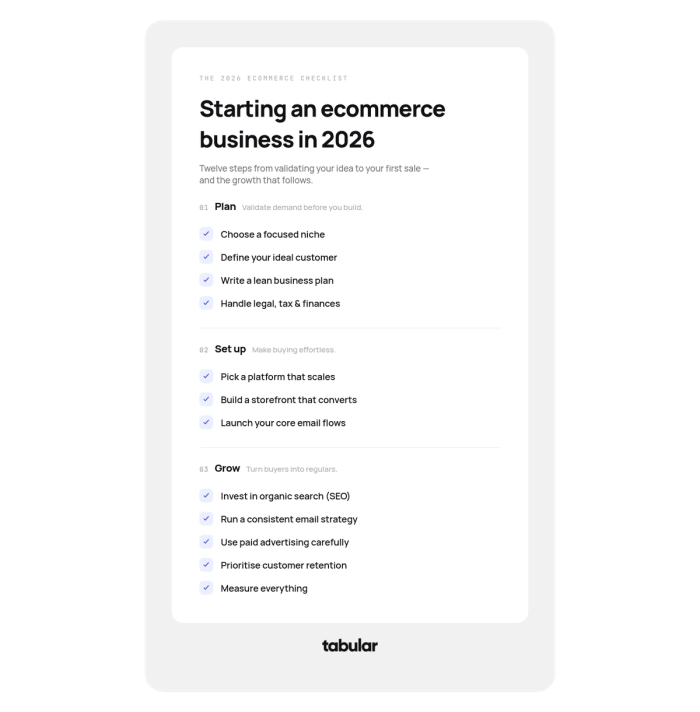
The difference between a store that grows and one that stalls often comes down to preparation. If you're researching how to start an ecommerce business in 2026, a structured approach can help you avoid costly mistakes and build a business that scales.
This checklist covers the key decisions you'll need to make before launch, along with the systems and marketing strategies that can support long-term growth.
Why Start an Ecommerce Business in 2026?
Ecommerce continues to expand across virtually every industry. Consumers expect convenience, fast delivery, and seamless online experiences. At the same time, advancements in AI, automation, and digital marketing have made it easier for small businesses to compete with larger brands.
But accessibility cuts both ways. While launching a store is easier than ever, standing out has become significantly harder. Most new ecommerce businesses aren't competing against a handful of local retailers. They're competing against established brands, marketplaces, and dozens of niche competitors targeting the same audience.
The opportunity in 2026 isn't simply to sell products online. It's to build a brand customers trust, create memorable buying experiences, and develop repeatable revenue streams that aren't entirely dependent on paid advertising.
Plan Your Ecommerce Business
Many ecommerce businesses fail before they gain momentum because they launch without validating demand.
A common mistake is investing heavily in branding, website design, or inventory before confirming that customers are willing to buy. The strongest ecommerce businesses typically start with customer research, market validation, and a clear understanding of how they'll acquire their first 100 customers.
Choose a Niche
Broad product catalogues are difficult to market and even harder to differentiate. Most successful ecommerce brands start by solving a specific problem for a specific audience.
Instead of asking, "What products should I sell?" ask, "What customer problem can I solve better than existing alternatives?"
For example, a store selling general fitness equipment will likely struggle against major retailers. A brand focused on mobility tools for runners recovering from injury has a far clearer position in the market.
When evaluating potential niches, consider:
- Market demand
- Competitive landscape
- Product margins
- Shipping complexity
- Customer lifetime value
- Opportunities for repeat purchases
The last point is particularly important. Products customers buy repeatedly are often easier to scale profitably than one-time purchases.
Google's SEO Starter Guide is a useful resource for understanding how customers discover products through search and what content opportunities may exist within your niche.
Define Your Ideal Customer
Understanding your audience influences nearly every decision you'll make, from product selection to advertising strategy.
Many new store owners create broad customer personas that describe everyone and no one at the same time. Instead, focus on a narrow customer segment first. It's often easier to expand later than it is to build relevance with an audience that's too broad.
Create a simple customer profile that includes:
- Demographics
- Buying motivations
- Common pain points
- Preferred shopping channels
- Budget expectations
The clearer your understanding of the customer, the easier it becomes to create product pages, advertisements, and emails that feel personally relevant.
Create a Business Plan
You don't need a 50-page business plan, but you should document the fundamentals:
- Revenue goals
- Startup costs
- Marketing budget
- Fulfilment strategy
- Customer acquisition plan
- Growth milestones
The U.S. Small Business Administration business guide provides practical frameworks for building a business plan that can guide your decision-making during the first few years.
A documented plan also makes it easier to identify whether your business is progressing as expected or drifting off course.
Handle Legal and Financial Requirements
Tax compliance may not be the most exciting part of building an ecommerce business, but ignoring it can become expensive as your store grows.
Many founders don't think about sales tax obligations until they begin selling across multiple states or jurisdictions. By then, the process becomes far more complicated.
Investing in reliable sales tax automation software can reduce administrative overhead and help ensure compliance as your business scales.
You should also:
- Register your business properly
- Open a dedicated business bank account
- Establish bookkeeping processes
- Understand local and international tax requirements
- Separate personal and business finances
Think of these systems as infrastructure. Customers may never notice them, but they make your business far easier to manage as sales increase.
Set Up Your Ecommerce Store
Once your business strategy is in place, it's time to build your storefront.
The goal of your website isn't to impress visitors. It's to make buying easy.
Many ecommerce stores lose sales because they prioritise visual design over usability. Customers care less about flashy animations and more about quickly finding products, understanding what they're buying, and completing checkout without friction.
Select an Ecommerce Platform
Your ecommerce platform serves as the foundation of your business.
Look for features such as:
- Mobile optimisation
- Inventory management
- Secure payment processing
- Marketing integrations
- Scalability
- Analytics and reporting
Avoid choosing a platform solely based on price. Migrating later can be expensive, time-consuming, and disruptive.
The best platform is usually the one that can support your business not just today, but also two or three years from now. For businesses anticipating future growth, ecommerce platforms can be a suitable option, offering the flexibility to adapt as operational and customer requirements evolve.
Create a Professional Storefront
Trust is one of the most important conversion factors in ecommerce.
Visitors should be able to answer three questions within seconds of landing on your site:
- What do you sell?
- Why should I trust you?
- Why should I buy from you instead of a competitor?
Every element on your storefront should help answer one of those questions.
A professional ecommerce website should include:
- High-quality product photography
- Detailed product descriptions
- Clear navigation
- Transparent shipping information
- Accessible customer support
- Fast-loading pages
Remember that even small points of friction can reduce conversion rates.
Build Your Email Marketing Foundation
One of the most overlooked realities of ecommerce is that most visitors won't buy during their first visit.
That's why email remains such a valuable channel. It gives you a way to continue the conversation after a visitor leaves your website.
Before launch, establish key customer journeys and automated campaigns. These foundational ecommerce email flows can help recover abandoned carts, welcome new subscribers, and drive repeat purchases.
Many successful ecommerce brands generate a significant percentage of their revenue from automated email programmes alone.
How to Grow Your Ecommerce Business After Launch
Launching your store is only the beginning.
Growth isn't about finding a single winning channel. It's about building a system where multiple channels work together.
The brands that scale most effectively combine SEO, email marketing, paid acquisition, customer retention, and referral programmes into a cohesive growth strategy.
Invest in Organic Search
Organic search takes time, but it often delivers some of the highest-quality traffic available.
Unlike paid advertising, which stops generating traffic the moment you stop spending, SEO can continue producing results for months or even years.
Focus on:
- Product page optimisation
- Category page optimisation
- Educational content
- Internal linking
- Technical SEO improvements
This makes content creation particularly valuable for ecommerce brands operating in competitive markets.
Develop a Consistent Email Strategy
After launch, email marketing should become a core part of your customer retention strategy.
Learning the fundamentals of creating marketing emails that engage subscribers can significantly improve customer retention and repeat purchase rates.
Rather than sending only promotional campaigns, balance sales messages with educational content, product recommendations, and customer success stories.
The strongest ecommerce email programmes feel helpful rather than purely transactional.
Use Paid Advertising Carefully
Paid media can accelerate growth, but it shouldn't be your entire growth strategy.
Many ecommerce businesses become overly dependent on Meta or Google Ads. This works until advertising costs rise or platform algorithms change.
Recent developments such as Meta's Andromeda update highlight how rapidly advertising platforms are evolving through AI-driven optimisation.
Start by closely monitoring:
- Customer acquisition cost
- Return on ad spend
- Conversion rate
- Average order value
- Customer lifetime value
The goal isn't simply to generate traffic. It's to acquire customers profitably.
Prioritise Customer Retention
Acquiring a customer is expensive. Keeping one is usually much cheaper.
This is why experienced ecommerce operators pay close attention to customer lifetime value, repeat purchase rate, and retention metrics.
Consider implementing:
- Loyalty programmes
- Referral incentives
- Personalised product recommendations
- Post-purchase email campaigns
- VIP customer rewards
Even modest improvements in retention can have a greater impact on profitability than significant increases in traffic.
When customers buy repeatedly, your business becomes less dependent on advertising spend and more resilient during market fluctuations.
Measure Everything
Successful ecommerce businesses rely on data, not assumptions.
Track key metrics including:
- Revenue
- Conversion rate
- Average order value
- Customer lifetime value
- Repeat purchase rate
- Email engagement
- Advertising performance
Consistent measurement helps identify opportunities before they become problems.
The brands that improve fastest are often the ones that review performance regularly and make small adjustments based on real customer behaviour.
Conclusion
Learning how to start an ecommerce business in 2026 involves more than choosing products and launching a website. Success depends on thoughtful planning, operational discipline, and a willingness to continuously optimise your marketing and customer experience.
The businesses that thrive are typically not the ones with the biggest launch budgets. They're the ones that build strong foundations, understand their customers, and consistently improve over time.
Treat this checklist as a starting point, focus on executing the fundamentals well, and you'll be in a much stronger position to build an ecommerce business that grows beyond its first year.