
11 B2B Marketing Examples From Real Campaigns (With Results)
Table of contents
- What is a B2B marketing example?
- 1. Instacart — Same-As-In-Store Pricing Launch
- 2. HackerOne — "Cyberstrength" Brand Reposition
- 3. Fieldguide — Multi-Touch Awareness for Agentic AI
- 4. Bloomreach — Hyper-Segmented Brand Campaign
- 5. J.P. Morgan Payments — Enterprise ABM Pilot
- 6. Instacart — Scaling B2B Content & Education
- 7. Flashfood — B2B Go-To-Market Repositioning
- 8. B2B Electronics Manufacturer — Amazon Ads Strategy
- 9. KPMG — "Consumer Products" Brand Refresh
- 10. Spotify Advertising — "All Ears on You"
- 11. Investors Associated — Omni-Channel Growth in Real Estate
- What these B2B marketing examples have in common
- Frequently asked questions
- Putting these B2B marketing examples to work
Key Takeaways:
This article breaks down 11 real B2B marketing examples — from Instacart, KPMG, Spotify, J.P. Morgan Payments, Bloomreach, HackerOne, and others — each analyzed the same way: objective, audience, channels, creative approach, results, and takeaway.
- Real campaigns beat abstractions. Instead of "build trust" advice, you get the actual channel picks, creative bets, and numbers from campaigns spanning ABM pilots, brand repositioning, content programs, paid media, and go-to-market launches.
- Audience precision beats audience size. The winners narrowed before they widened — Bloomreach geofenced job titles, J.P. Morgan targeted three named accounts, Fieldguide ran DOOH inside the top 50 accounting firms' lobbies.
- Creative is the unfair advantage in "boring" categories. KPMG's consumer-products spoof beat industry CTR by 480%, Spotify wrote songs for CMOs, and HackerOne reframed "hacker" into "Cyberstrength."
- Multi-channel is the floor, not the ceiling. The strongest examples coordinated DOOH, CTV, paid social, podcasts, content, email, and ABM rather than betting on a single channel.
- Measurement separates examples from anecdotes. The most useful cases come with hard numbers — CTRs, lifts, qualified leads, revenue growth — so you can actually replicate them.
- Brand and demand work together. Awareness campaigns warm accounts so demand work can convert them; treating them as separate budgets is how programs underperform.
- Apply one, not five. Map a single example to your own constraints — audience, channel mix, creative concept, KPI — and rebuild its structure for your category.
Most articles about B2B marketing trade in abstractions: "build trust," "lead with value," "align sales and marketing." Useful, but not actionable. What actually moves pipeline in b2b marketing is studying what real teams did — the channels they picked, the creative bets they made, the numbers that came back.
.png?w=700&fit=max&auto=format)
This article collects eleven B2B marketing examples from companies like Instacart, KPMG, Spotify, J.P. Morgan Payments, Bloomreach, and HackerOne. Each one is broken down the same way: the objective, the audience, the channels, the creative approach, the results, and the takeaway. Some of these campaigns leaned on hyper-targeted account-based motions. Others used bold creative to break through in "boring" categories. A few quietly scaled content over 18 months. Together they cover most of the playbook a modern B2B marketer is working from in 2026.
If you're auditing your own program, building a pitch deck, or just trying to figure out what to test next quarter, these B2B marketing examples should give you something concrete to work with.
What is a B2B marketing example?
A B2B marketing example is any campaign or program where a business is selling to another business — not a consumer. That distinction matters because it changes almost everything: longer sales cycles, buying committees instead of individuals, higher contract values, and channels that skew toward LinkedIn, search, content, events, and ABM rather than TikTok and influencer drops.
The eleven examples below span ABM pilots, brand repositioning, multi-channel awareness campaigns, content programs, paid media optimization, and go-to-market launches. If you're newer to the discipline, the B2B email marketing guide and the breakdown of brand awareness vs. demand generation vs. lead generation are useful primers before diving in.
1. Instacart — Same-As-In-Store Pricing Launch
Instacart needed a rapid, high-impact campaign to promote its new same-as-in-store pricing at select retailers. In just four weeks, Column Five's team embedded with Instacart's marketing group to co-create over 115 campaign assets across every channel — CTV, OOH, streaming audio, paid social, display, direct mail, and email. The agency used hyperlocal insights to tailor messaging to regional audiences and iterated live on creative briefs.
The multichannel blitz became a cornerstone of Instacart's pricing strategy: retailers offering price parity saw sales grow roughly 10 percentage points faster than those with markups. An agile, embedded approach delivered scale and speed, with performance cited by Instacart leadership.
| Attribute | Details |
|---|---|
| Industry | Grocery delivery / eCommerce |
| Objective | Raise awareness of same-as-store pricing; drive adoption in priority markets |
| Target audience | Independent grocers and regional consumers in target markets |
| Channels | Paid social, display ads, grocery TV, direct mail, email, streaming audio, CTV, OOH |
| Creative approach | Hyperlocal messaging emphasizing price parity; rapid prototyping of 115+ assets via embedded, agile collaboration |
| Timeline | 4-week sprint |
| Results | Retailers with price parity grew ~10 pp faster than those with markups |
| Takeaway | Embedding the agency team with the client cuts approval time and increases velocity. Bold messaging plus local insight amplifies impact across marketing channels. |
2. HackerOne — "Cyberstrength" Brand Reposition
.png?w=700&fit=max&auto=format)
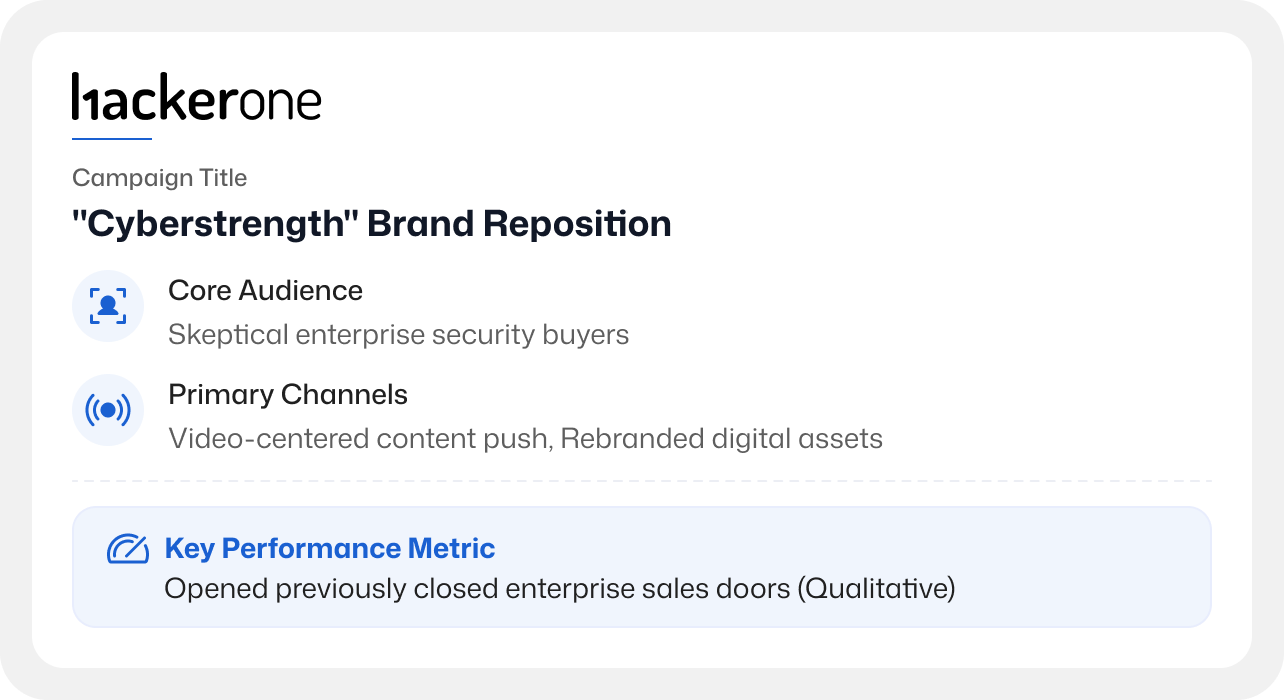
HackerOne, known for ethical hacking, struggled to break into enterprise security because of negative "hacker" connotations. Column Five crafted a full brand repositioning around the concept of "Cyberstrength," shifting messaging from reactive security to proactive risk management. The campaign updated HackerOne's visual identity with bold, future-focused graphics — vibrant pinks and blues, a new arrow motif — and launched a video-centered content push.
Though no numeric KPIs are public, the effort opened enterprise doors that had previously been closed by reframing HackerOne's identity. A brand liability became a differentiator, enabling sales to engage large accounts that had been skeptical of the "hacker" label.
| Attribute | Details |
|---|---|
| Industry | Cybersecurity (Enterprise) |
| Objective | Break into enterprise market by reframing brand identity |
| Target audience | Enterprise CISOs and security executives |
| Channels | Brand campaign with new video, digital content, and corporate positioning |
| Creative approach | "Cyberstrength" concept with dynamic, future-focused visuals and messaging |
| Results | Enterprise deal pipeline increased; perception obstacle overcome |
| Takeaway | If a buyer objection is embedded in your brand, repositioning is required — a strong creative idea can become an asset when reframed. |
3. Fieldguide — Multi-Touch Awareness for Agentic AI
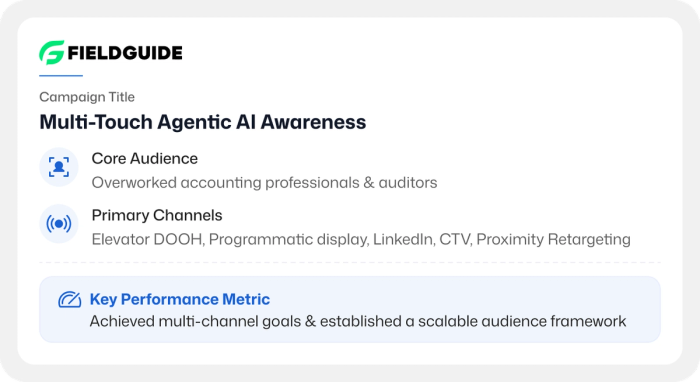
Fieldguide launched an agentic AI platform for auditors, targeting overworked accounting professionals who were wary of AI. The agency's solution was an in-your-face, multi-channel awareness campaign that presented the AI as a "field agent" rather than a tech novelty. Execution involved building a landing page, hero video, and campaign assets with a consistent visual theme — green gradients, sleek shapes.
The paid-media mix was highly targeted: DOOH ads in the lobbies and elevators of the top 50 accounting firms, programmatic and LinkedIn ads, CTV placements, and cross-device retargeting triggered by proximity (i.e., seeing the DOOH ad). Numeric KPIs aren't public, but Column Five reports the campaign hit Fieldguide's goals and established a scalable framework for reaching professional B2B audiences.
| Attribute | Details |
|---|---|
| Industry | Accounting technology / Enterprise software |
| Objective | Launch awareness of AI audit platform among accounting professionals |
| Target audience | Auditors and finance professionals at large accounting firms |
| Channels | DOOH in accounting firm offices, CTV/OTT video, LinkedIn/programmatic targeting, cross-device retargeting |
| Creative approach | Messaging of "agentic AI" as a diligent field agent; visual consistency across assets |
| Timeline | Multi-month integrated campaign |
| Results | Goals met; pioneered a framework for reaching professional audiences with cross-channel targeting |
| Takeaway | When an audience is skeptical of new tech, lead with familiar outcomes (improved workflow) and surround them in context — physical touchpoints plus retargeting. |
4. Bloomreach — Hyper-Segmented Brand Campaign
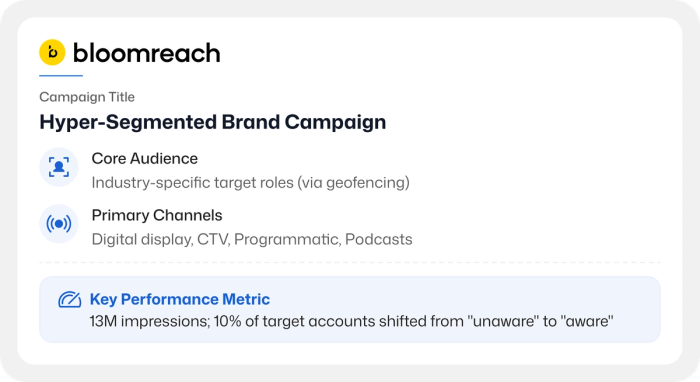
Bloomreach, an e-commerce personalization platform, ran its first-ever brand campaign to boost awareness among new audiences. The agency used hyper-segmentation and real-time testing. Audiences were defined by geofences, industry-specific job titles, and historical data. Ads ran across digital display, CTV, programmatic, podcasts, and other channels, with continuous performance monitoring and live budget reallocation.
The campaign exceeded goals: 10% of target accounts moved from "unaware" to "aware," it delivered 13 million impressions, and 429,000 completed audio listens at an average cost of $0.03. The multi-channel, test-and-learn approach achieved roughly a 30% lift over plan and gave Bloomreach a strong brand launch.
| Attribute | Details |
|---|---|
| Industry | MarTech / E-commerce |
| Objective | Build brand awareness with targeted new accounts |
| Target audience | E-commerce and retail decision-makers (target account list) |
| Channels | Digital display, Connected TV, programmatic video/audio, podcasts |
| Creative approach | "Be Limitless" messaging with geofenced, job-title targeting; agile media mix with continuous testing |
| Results | 10% of target accounts moved to aware; 13M impressions; 429K audio listens at $0.03 each; +30% over goals |
| Takeaway | Even brand campaigns benefit from real-time optimization. Segment narrowly, then broaden. Test and adjust continuously. |
5. J.P. Morgan Payments — Enterprise ABM Pilot
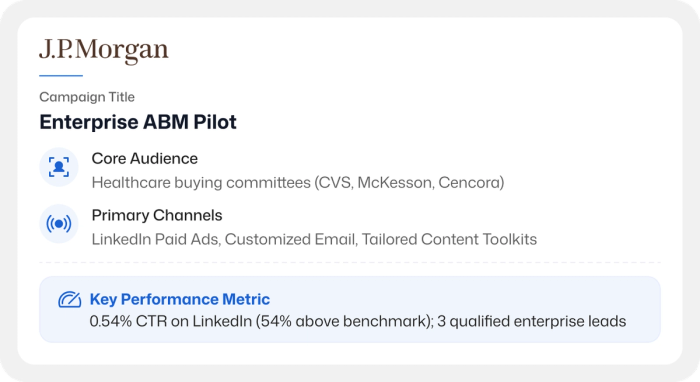
J.P. Morgan Payments' Healthcare division needed to change enterprise buyers' perceptions of the brand from "legacy bank" to modern fintech. Column Five ran a targeted Account-Based Marketing pilot focused on three healthcare companies (CVS, McKesson, Cencora). The campaign spanned paid LinkedIn ads and content assets for the full buying committee — finance, IT, operations.
Deliverables included account-specific messaging, a content toolkit (whitepapers, eBooks, landing page, pitch deck), and a LinkedIn-plus-email engagement strategy. Results: a 0.54% CTR on LinkedIn ads (54% above the B2B benchmark of 0.35%) and three qualified enterprise leads — more than all prior Healthcare campaigns combined. The pilot proved that tailored ABM content could close a perception gap and produce tangible lead value, with each lead representing multimillion-dollar potential.
| Attribute | Details |
|---|---|
| Industry | Financial services (Payments & Treasury) |
| Objective | Shift enterprise healthcare buyers' perception; generate marketing-qualified leads via ABM |
| Target audience | Buying committees at key healthcare companies (CVS, McKesson, Cencora) |
| Channels | LinkedIn paid media, account-specific emails, sales enablement content (whitepapers, eBooks) |
| Creative approach | Content-led ABM with personalized messaging for each account's committee |
| Results | 0.54% LinkedIn CTR (+54% above benchmark); 3 qualified enterprise leads (first marketing-sourced leads for the team) |
| Takeaway | ABM can break through stale brand perceptions. Target the full buying committee with tailored content — work from a clear ICP, not just a buyer persona — and use small-scale pilots to prove ROI in strategic sectors. |
6. Instacart — Scaling B2B Content & Education
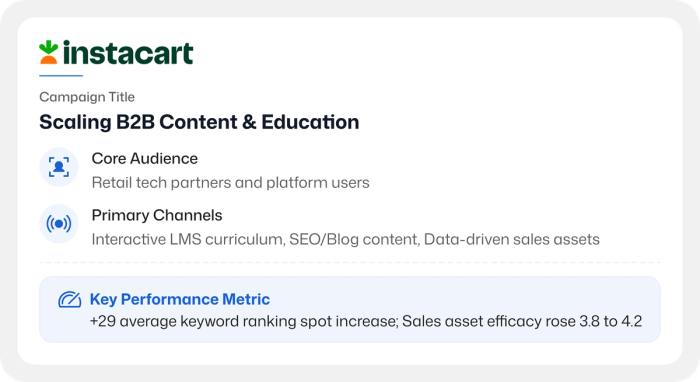
Instacart's retail tech ("Ads and Platform") teams partnered with Column Five to scale their B2B content marketing. Over 18 months, the agency delivered more than 200 projects across seven teams. Key initiatives included an Instacart Ads Academy — an interactive LMS curriculum to train retail partners — and a steady blog content and SEO program.
The SEO work drove a 29-spot average ranking increase on targeted keywords. The team also produced data-driven sales assets timed to peak shopping seasons, which lifted the sales team's efficacy rating from 3.8 to 4.2 on a 5-point scale. These behind-the-scenes efforts helped grow Instacart's B2B momentum (the company went public in 2023) and earned the agency a reputation as a "gold standard" extension of the marketing team.
| Attribute | Details |
|---|---|
| Industry | E-commerce / Retail technology |
| Objective | Scale Instacart's B2B marketing across ads platform and retail tech |
| Target audience | Retailers and advertising partners (e.g., supermarkets using Instacart Ads) |
| Channels | Content marketing (blogs, SEO), interactive training platform (LMS), data-driven sales content |
| Timeline | 18-months |
| Results | +29 average ranking spots on target keywords; sales team efficacy 3.8 → 4.2; 200+ assets produced |
| Takeaway | A content and education strategy multiplies impact across teams. Consistent SEO and usable training content drive long-term B2B growth |
7. Flashfood — B2B Go-To-Market Repositioning
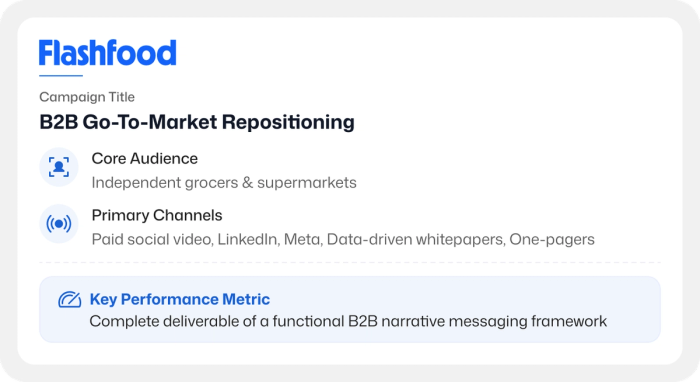
Flashfood, a grocery discount app, needed to reposition its consumer-friendly brand for independent grocers. Column Five built a "Rethink Your Shrink" go-to-market campaign that recast Flashfood as a revenue-generation partner, not just a discount tool.
The accelerated rollout included data-driven whitepapers, two 30-second AI-assisted videos produced in days, paid social video and text ads on LinkedIn and Meta, and concise one-pagers. The core creative message focused on reducing food waste ("shrink") and cultivating customer loyalty, aligning with grocers' profit goals. Quantitative results aren't public, but the campaign delivered a complete B2B messaging system, giving Flashfood sales teams new talking points.
| Attribute | Details |
|---|---|
| Industry | Retail / Grocery tech |
| Objective | Reposition consumer app brand as a strategic partner for grocery stores |
| Target audience | Independent grocery store owners and operators |
| Channels | LinkedIn and Meta paid ads (video and text), whitepapers, explainers, one-pagers |
| Creative approach | "Rethink Your Shrink" theme; data-driven storytelling, AI-assisted video production |
| Results | Complete B2B asset suite delivered; brand successfully repositioned as a revenue partner |
| Takeaway | Translate consumer brand equity into business language. Focus on clients' bottom line (revenue from wasted stock) and use agile production tools — including AI video — to compress campaign timelines. |
8. B2B Electronics Manufacturer — Amazon Ads Strategy
A network-cabinet manufacturer wanted profitable growth on Amazon. ROI Revolution audited the brand's Sponsored Ads, shifted some budget to Amazon DSP, optimized product feeds, added negative keywords, and leveraged Sponsored Display vCPM ads.
Month-over-month results: sales +55%, impressions +32%, clicks +15%, orders +52%, and a 6% lift in ROAS. The client's overall Amazon business also grew (+16% sales, +18% sessions). This case shows how to use Amazon's full advertising ecosystem — DSP plus Sponsored campaigns — to outmaneuver rising competition and extract more value per ad dollar.
| Attribute | Details |
|---|---|
| Industry | B2B electrical / IT hardware |
| Objective | Counteract competitive pressure on Amazon; increase sales profitably |
| Target audience | B2B IT buyers and distributors searching on Amazon |
| Channels | Amazon DSP, Sponsored Products, Sponsored Display |
| Creative approach | Optimized ad creative and keywords; detailed audience targeting via DSP |
| Results | MoM: Sales +55%, Impressions +32%, Clicks +15%, Orders +52%, ROAS +6%; overall Amazon sales +16%, sessions +18% |
| Takeaway | Audit ad spend and reallocate to more effective channels (e.g., shift from vCPM to DSP). Continuous content and feed optimization compounds. |
9. KPMG — "Consumer Products" Brand Refresh
KPMG's consumer and retail advisory practice needed to stand out during a downturn. They launched a tongue-in-cheek campaign positioning KPMG as consumer products themselves — mock CPG items — across print, display, paid social, and DOOH. The creative provoked brand awareness and empathy by speaking the language of consumer-led businesses.
Results were outstanding: a 480% higher CTR than industry norms, more than 9 million impressions, an 11% increase in sales opportunities, and a 68% uplift in opportunity value for the Consumer Consulting division. The case shows that bold, category-blurring creative combined with broad and targeted media can dramatically amplify engagement, even in B2B professional services.
| Attribute | Details |
|---|---|
| Industry | Professional services (Consulting) |
| Objective | Refresh brand for consumer-focused advisory; generate leads in CPG segment |
| Target audience | Consumer products and retail business leaders |
| Channels | Print ads, digital display, paid social (LinkedIn), digital out-of-home |
| Creative approach | "KPMG Consumer Products" spoof — KPMG-branded everyday goods |
| Timeline | ~5-month campaign |
| Results | CTR ~480% above industry norm; >9M impressions in 3 weeks; +11% opportunity volume; +68% opportunity value |
| Takeaway | Even in "boring" B2B sectors, memorable creative plus media scale can massively beat benchmarks. |
10. Spotify Advertising — "All Ears on You"
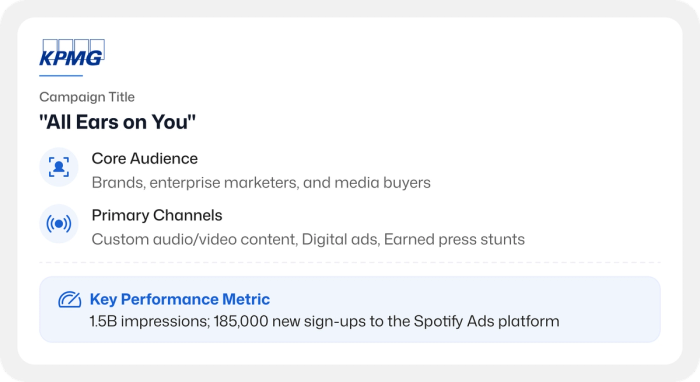
Spotify's advertising arm ran "All Ears on You," a creative audio campaign showcasing the power of Spotify's ad products. The centerpiece was A Song For Every CMO, a series of original songs for marketers, plus a short film depicting listeners absorbed in music. The omnichannel effort targeted brands and media buyers with digital ads and content.
The campaign achieved 1.5 billion impressions, engaged 10,000 targeted decision-makers, and drove 185,000 new sign-ups to the Spotify Ads platform. It demonstrated Spotify Ads' reach (including earned press) and significantly expanded the B2B customer base. The takeaway: novel creative stunts paired with broad media can yield massive reach and qualified interest in B2B tech.
| Attribute | Details |
|---|---|
| Industry | Digital audio advertising |
| Objective | Promote Spotify's advertising platform to brands and media buyers |
| Target audience | Marketing executives at major brands |
| Channels | Custom film and audio content (original songs), digital ads, PR/earned media |
| Creative approach | Interactive "All Ears on You" campaign with original songs for CMOs |
| Results | 1.5B impressions; 10,000 high-value targets engaged; 185,000 new platform sign-ups |
| Takeaway | Creativity (custom content) plus scale can rapidly raise awareness and user acquisition in B2B tech. |
11. Investors Associated — Omni-Channel Growth in Real Estate
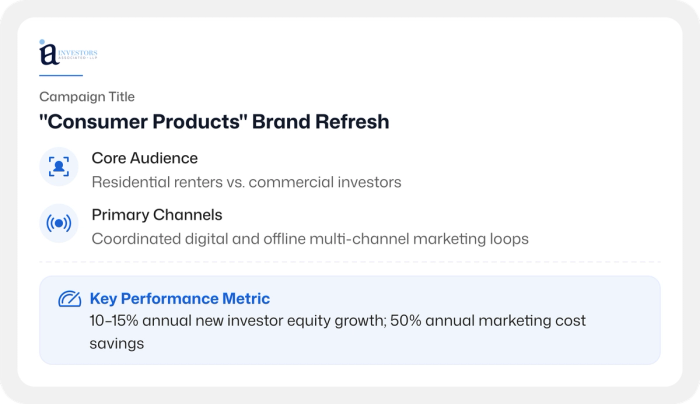
Investors Associated, a real-estate development firm, faced stagnating equity growth without a focused marketing strategy. Over a five-year partnership, the agency designed a tailored omnichannel marketing system. They segmented the audience — residential renters versus commercial investors — and rolled out coordinated digital and offline campaigns.
The results were steady: new investor equity grew roughly 10–15% per year, occupancy stayed near capacity, and outsourcing marketing delivered about 50% annual cost savings. Even traditional industries can drive measurable business results — revenue growth and cost efficiency — through an intentional, data-driven marketing overhaul.
| Attribute | Details |
|---|---|
| Industry | Real estate (Residential and commercial investment) |
| Objective | Attract new equity investors and partners |
| Target audience | Residential renters and commercial property investors |
| Channels | Omnichannel: targeted content, email, events, social |
| Creative approach | Customized messaging based on investor persona and property type |
| Timeline | 5-year partnership |
| Results | 10–15% annual growth in new equity; high occupancy maintained; 50% annual marketing cost reduction |
| Takeaway | Deep understanding of niche audience plus coordinated messaging can sustainably grow B2B revenues and cut costs. |
Frameworks like the SOSTAC marketing model help structure that kind of long-term plan.
What these B2B marketing examples have in common
Across eleven very different campaigns — different industries, budgets, and timelines — a few patterns are hard to miss.
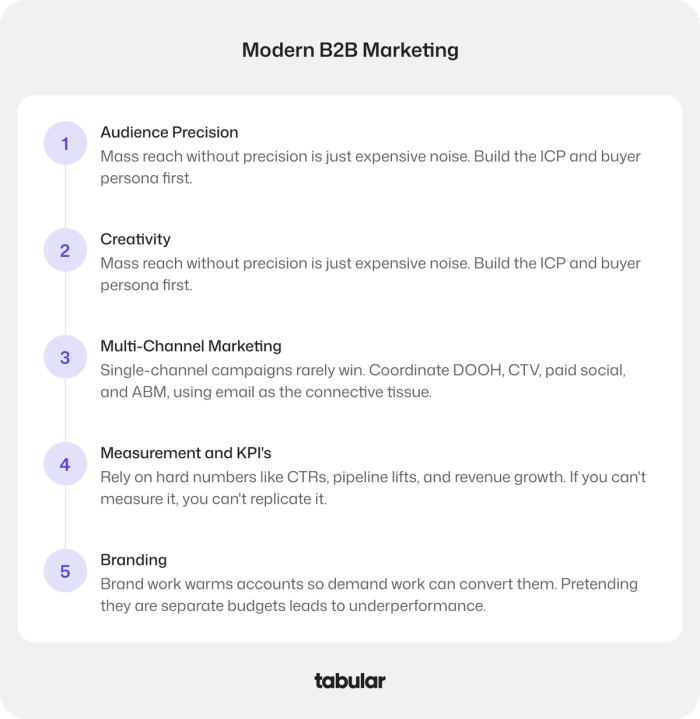
Audience precision beats audience size. Almost every winning example narrowed before it widened. Bloomreach geofenced job titles. J.P. Morgan picked three accounts. Fieldguide put DOOH ads inside the lobbies of the top 50 accounting firms. Mass reach without precision is just expensive noise. Build the ICP and buyer persona work first.
Creative is the unfair advantage in B2B. KPMG's consumer-products spoof beat industry CTR benchmarks by 480%. Spotify wrote songs for CMOs. HackerOne reframed "hacker" into "Cyberstrength." In categories that everyone else treats as boring, creativity is leverage.
Multi-channel is the floor, not the ceiling. Single-channel campaigns barely show up in this list. The strongest examples coordinated DOOH, CTV, paid social, podcasts, content, email, and ABM — and used b2b email marketing as the connective tissue for nurture and follow-up.
Measurement is what separates examples from anecdotes. Notice how the most-cited cases here come with hard numbers: CTRs, lifts, qualified leads, revenue growth. If you can't measure it, you can't replicate it. A simple campaign metrics framework goes a long way.
Brand and demand work together. The Bloomreach awareness campaign and the J.P. Morgan ABM pilot are usually framed as opposites. They aren't. Brand work warms accounts so demand work can convert them. Pretending they're separate budgets is how programs underperform.
Frequently asked questions
What is a good example of B2B marketing?
A strong B2B marketing example combines a clear audience, a sharp creative angle, and measurable results. J.P. Morgan Payments' ABM pilot is a good archetype: three target accounts, tailored content for the full buying committee, LinkedIn-plus-email engagement, and 54% above-benchmark CTR with three multi-million-dollar qualified leads. KPMG's Consumer Products spoof is another — bold creative paired with multi-channel reach delivering a 480% CTR lift over industry norms.
What's the difference between B2B and B2C marketing examples?
B2C marketing examples typically optimize for individual emotional triggers, short purchase cycles, and high-volume conversion. B2B marketing examples optimize for buying committees, longer cycles, account-level targeting, and content-heavy nurture. The HackerOne and Fieldguide cases above are pure B2B because the buyers are organizations with multiple stakeholders, not individuals. For deeper context, see B2B vs. B2C2B vs. B2B2C.
Which channels appear most often in successful B2B marketing examples?
LinkedIn paid ads, account-specific email, content marketing and SEO, programmatic display and CTV, and increasingly Connected TV and DOOH for high-value targets. Almost every example above used at least three channels in coordination. A primer on selecting channels is in the marketing channels guide.
How do I apply these B2B marketing examples to my own program?
Start by mapping each example to your own constraints. If you have a small target list and big-deal economics, J.P. Morgan's ABM pilot is closest. If you're launching a new category, Fieldguide's coordinated DOOH-plus-retargeting model fits. If you need to defend Amazon margins, the B2B Electronics case is the template. Then pick one campaign — not five — and replicate the structure: audience definition, channel mix, creative concept, and measurement plan.
What role does email play in these B2B marketing examples?
Email shows up across almost every case as either a primary nurture channel (J.P. Morgan, Investors Associated, Instacart) or a connective tissue between paid touchpoints (Fieldguide, Flashfood). It's the channel that owns the customer relationship between ad impressions and sales conversations. The email customer journey mapping guide covers how to design that flow.
Putting these B2B marketing examples to work
The campaigns above aren't templates to copy line-by-line. They're proof of what's possible when audience precision, creative ambition, and measurement discipline meet at the same time. Pick one example that maps to your own constraints, strip it down to its structural decisions — who, what channels, what creative bet, what KPI — and rebuild it for your category.
Build beautiful emails in minutes
Email runs through nearly every example above — as the primary nurture channel for J.P. Morgan, Instacart, and Investors Associated, and as the connective tissue between paid touchpoints for Fieldguide and Flashfood. If email is part of the program you're rebuilding, the assets have to render cleanly across every client your buying committee actually uses.
Tabular is a no-code, drag-and-drop email builder that turns your design into pixel-perfect email HTML, rendering correctly across 50+ email clients including older Outlook, then exports as HTML or PDF or pushes straight to the ESP you already send with. You can start with professional html email templates for free and customize them to your campaign — the fastest way to turn an ABM nurture sequence or a launch email into something that holds up in the inbox.