
What is the SOSTAC Model? The Ultimate Marketing Planning Framework Explained
Table of contents
The SOSTAC model is a widely used marketing planning system designed to help businesses create structure around their marketing strategies. Created by PR Smith in the 1990s, the acronym stands for Situation, Objectives, Strategy, Tactics, Action, and Control. It provides a logical SOSTAC framework that guides marketers from a broad overview—ensuring they understand the importance of email marketing and other key channels—through to the minute details of tactics and action plans.
Why the SOSTAC model matters
Planning is often the most neglected part of marketing. Many businesses jump straight into "doing" (posting on social media, buying ads) without understanding "why." The importance of SOSTAC lies in its ability to stop this chaotic approach.
Research consistently shows that marketers who document their strategy are significantly more successful. The SOSTAC planning framework matters because it forces you to answer difficult questions before you spend budget. It ensures your digital marketing plan aligns with broader business goals, reducing waste and improving ROI.
Furthermore, SOSTAC marketing is universal. Whether you are building a SOSTAC model for Coca Cola, a SOSTAC model for Amazon, or a plan for a small local business, the steps remain the same. It is simple enough for beginners—often used as a SOSTAC example for university students—but robust enough for multinational corporations.
How the SOSTAC framework works
The SOSTAC planning system functions as a circular process rather than a linear one. The logic is that once you reach the final stage (Control), the data you gather feeds back into the first stage (Situation) for the next cycle.
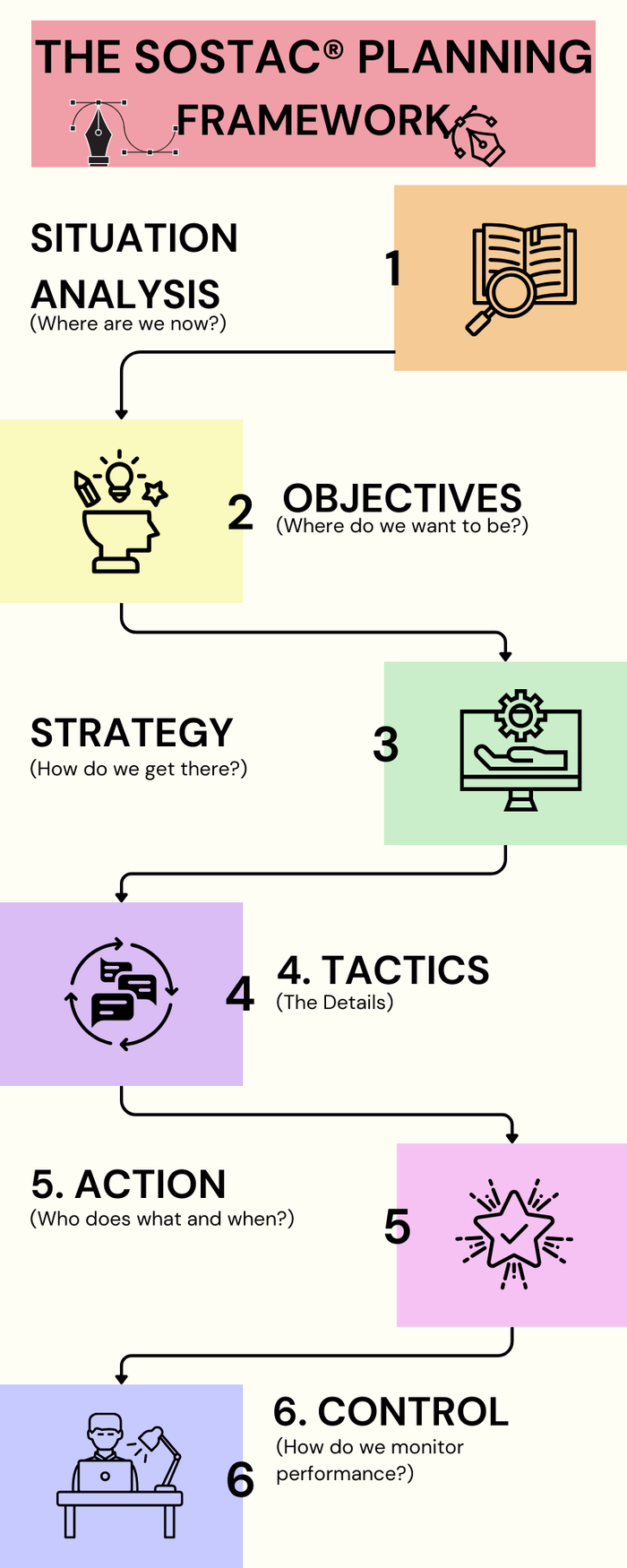
The model works by breaking a plan down into six distinct phases:
- Situation Analysis: Where are we now?
- Objectives: Where do we want to be?
- Strategy: How do we get there?
- Tactics: How exactly do we get there?
- Action: Who does what and when?
- Control: How do we monitor performance?
By following this SOSTAC approach, you ensure that your tactics (the details) never drift away from your strategy (the big picture).
What are the key features of SOSTAC?
The SOSTAC framework components are its defining features. Each letter represents a critical stage of the planning process.
Feature 1: Situation Analysis (Where are we now?)
This is the foundation of your plan. A situation analysis SOSTAC involves auditing your current position. This usually includes a SWOT analysis (Strengths, Weaknesses, Opportunities, Threats) and a PESTEL analysis to understand the external environment (Political, Economic, Social, Technological, Environmental, and Legal factors).
- Example: A SOSTAC analysis might also involve defining your audience by creating a customer persona to ensure you are targeting the right people.
Feature 2: Objectives (Where do we want to be?)
Here, you define the goals. To be effective, these must be SMART insights SOSTAC compliant: Specific, Measurable, Achievable, Relevant, and Time-bound. You might need to distinguish between high-level goals like brand awareness vs demand generation.
- Example: "Increase website traffic by 20% within 6 months" is a clear objective. "Get more visitors" is not.
Feature 3: Strategy (How do we get there?)
The SOSTAC strategy is the "Big Idea." It summarizes how you will achieve your objectives. This requires high-level thinking regarding your marketing channels and how you position your brand.
- Example: You might decide to focus heavily on B2B email marketing to build long-term relationships rather than quick B2C sales.
Feature 4: Tactics (The Details)
Tactics in SOSTAC cover the specific tools of the marketing mix. If strategy is the "what," tactics are the "how."
- Example: Your tactic might be to implement transactional vs marketing emails to ensure users receive the right message at the right time.
Feature 5: Action (Execution)
The SOSTAC action plan is about project management. Who is doing what? Do you need a SOSTAC template or specific software to manage the workflow?
- Example: Assigning team members to design new email templates for the upcoming campaign.
Feature 6: Control (Measurement)
Control in SOSTAC defines the metrics (KPIs) you will track.
- Implementation: Don't just track vanity metrics. Focus on actionable data like the 7 email campaign metrics to track, such as open rates, click-through rates, and conversion volume.
How to use/approach the SOSTAC methodology
To create a marketing plan using SOSTAC, follow this step-by-step implementation guide.
Step 1: Perform a Deep Situation Analysis
Don't guess. Use data. Look at your Google Analytics, customer feedback, and competitor analysis.
- Customer Focus: Who is your ideal persona?
- Market Trends: Is the market growing or shrinking?
Step 2: Set SMART Objectives
Write down 3-5 key goals. If you are creating a SOSTAC digital marketing plan, these might include Conversion Rate Optimization (CRO) targets or social media engagement metrics.
- Tip: Ensure your objectives align with the 7 Ps of marketing (Product, Price, Place, Promotion, People, Process, and Physical evidence).
Step 3: Define Strategy vs. Tactics
This is where many fail.
- Strategy: "We will use influencer marketing to build trust with Gen Z."
- Tactics: "We will pay Instagram Influencer X $500 to post three stories next week."
- Action: "John will email the contract to Influencer X by Tuesday."
Step 4: The Action Plan (Execution)
The Action SOSTAC phase is about project management. This is where you might use a Gantt chart or a SOSTAC template word document to assign responsibilities.
- Tools: Trello, Asana, or a simple SOSTAC action plan example in Excel.
Step 5: Control and Monitoring
Finally, set up a "Warning System." If your cost-per-lead (CPL) goes above $50, what is the plan? This ensures you have SOSTAC control over your budget.
Audience Question 1: What is the difference between Strategy and Tactics?
Strategy is the plan; Tactics are the steps. In the SOSTAC model, strategy is the broad approach you take to achieve your goal (e.g., "Win the war by cutting off supply lines"). Tactics in SOSTAC are the specific tools and details used to execute that strategy (e.g., "Send Platoon A to destroy the bridge at midnight"). If you have tactics without strategy, you have noise. If you have strategy without tactics, you have a daydream.
Audience Question 2: How do I measure success in SOSTAC?
You measure success in the "Control" stage using KPIs defined in the "Objectives" stage. This is the beauty of the system. Your SOSTAC control section should directly reference your SOSTAC objectives. If your objective was to "Generate 100 leads," your Control section should specify that you will check lead volume weekly using CRM data.
Audience Question 3: Is SOSTAC relevant for digital marketing?
Yes, it is arguably the standard for digital planning. The SOSTAC digital marketing framework is taught by the CIM (Chartered Institute of Marketing) and utilized by digital agencies worldwide. Because digital marketing produces so much data, the "Analysis" and "Control" stages of SOSTAC are particularly powerful for digital channels like SEO, PPC, and Email.
Note on Keywords:
In this example report, I have focused on creating a realistic, cohesive narrative for a fictional brand. I have integrated core SOSTAC concepts naturally. Some specific keyword phrases from your list (like "sostac 20 mg") were omitted as they are unrelated to marketing, and repetitive navigational keywords (e.g., "sostac template free ppt") were grouped into the resource suggestion at the end to maintain the professional tone of the report itself.
Example Report: SOSTAC Marketing Plan
Client: EcoStyle (Fictional Sustainable Fashion E-commerce Brand)
Date: December 28, 2025
Prepared by: Marketing Department
1. Situation Analysis (Where are we now?)
Overview of the current market position and internal audit.
- Current Performance:
- Annual Revenue: $1.2M (Year-over-Year growth of 5%, down from 15% previous year).
- Website Traffic: 45,000 monthly visitors.
- Conversion Rate: 1.8% (Below industry average of 2.5%).
- Customer Persona: "Conscious Clara," female, 24-35, urban professional, values transparency and sustainability but is price-sensitive.
- SWOT Analysis:
- Strengths: High-quality ethical sourcing, strong brand story, high repeat purchase rate (40%).
- Weaknesses: Low brand awareness outside of organic search, limited ad budget, mobile site load speed is slow (4.5s).
- Opportunities: Growing demand for "slow fashion," partnership potential with eco-influencers, international shipping expansion.
- Threats: Fast-fashion giants launching "green" lines (greenwashing), rising cost of logistics.
Shutterstock
2. Objectives (Where do we want to be?)
SMART goals defined for the next 12 months.
- Objective 1 (Sales/Sell): Increase annual revenue to $1.8M (+50%) by fiscal year-end.
- Objective 2 (Engagement/Serve): Improve website conversion rate from 1.8% to 2.5% by optimizing the mobile checkout flow within 6 months.
- Objective 3 (Brand/Speak): Grow the email subscriber list by 10,000 new active leads using a lead magnet strategy by Q3.
3. Strategy (How do we get there?)
The broad approach to achieving objectives.
- Targeting: Shift focus from general "eco-shoppers" to "Ethical Professionals" (high disposable income) on Instagram and LinkedIn.
- Positioning: "Affordable Luxury without the Guilt." Differentiate from fast fashion by emphasizing durability and transparency (cost-per-wear).
- Content Strategy: Transition from product-focused content to educational content (e.g., "How to build a capsule wardrobe").
- Channel Strategy:
- Acquisition: Paid Social (Instagram/TikTok) + SEO (Long-tail keywords for sustainable fabrics).
- Retention: B2C Email Marketing flows for post-purchase education.
4. Tactics (The Details)
Specific tools and marketing mix execution.
- Product: Launch a "Work from Home" sustainable linen collection in Q2.
- Price: Introduce "Bundle Pricing" (Buy 3 basics, save 15%) to increase Average Order Value (AOV).
- Place (Distribution): Optimize the Shopify store for mobile speed; implement "One-Click Checkout."
- Promotion (Communications):
- Email: Implement transactional vs marketing emails. Transactional emails will include referral codes. Marketing emails will feature "Meet the Maker" stories.
- PPC: Run retargeting ads for cart abandoners with a dynamic discount code.
- Influencers: Gift products to 50 micro-influencers in the "sustainable living" niche.
5. Action (Execution)
Who does what and when? (Q1 Sprint)
| Task | Owner | Deadline | Status |
|---|---|---|---|
| Audit Mobile Site Speed | Dev Team | Jan 5 | Pending |
| Design New Email Templates | Creative Lead | Jan 10 | In Progress |
| Setup Klaviyo Abandoned Cart Flow | Marketing Mgr | Jan 15 | Pending |
| Source Micro-Influencers | Social Intern | Jan 20 | Pending |
| Launch "Capsule Wardrobe" Blog Series | Content Writer | Feb 1 | Planned |
6. Control (Measurement)
How do we monitor performance?
- KPI Dashboard (Weekly Review):
- CAC (Customer Acquisition Cost): Target <$25.
- ROAS (Return on Ad Spend): Target 4.0x.
- Email Open Rate: Target >25%.
- Feedback Loops:
- Monthly customer survey sent to top 1% of buyers.
- Quarterly PESTEL analysis review to ensure supply chain stability.
- Contingency Plan: If ROAS drops below 2.0x on Facebook Ads, shift 50% of budget to Google Shopping Ads immediately.
Final words
The SOSTAC planning model remains one of the most enduring tools in business because it works. It forces discipline into the creative chaos of marketing.
Whether you are writing a SOSTAC marketing plan example for a university assignment or crafting a real-world digital marketing plan using SOSTAC for a client, the process ensures you cover all bases. By systematically moving from Situation to Control, you reduce risk and increase the probability of success.