
What Jobs Are Safe from AI in the Future? 20 Careers with Bill Gates' Shortlist
Table of contents
- What the data actually says about AI and the workforce
- How the AI-Resistant Careers Index defines a "safe" job
- 20 jobs that are safe from AI in 2026
- The patterns hiding inside the list
- Bill Gates' shorter, sharper shortlist
- Transformation, not elimination — what the data actually means for your job
- Frequently asked questions about what jobs are safe from AI
- Where email — and direct human communication — still wins
- The takeaway
The question of what jobs are safe from AI in the future has stopped being theoretical. AI has moved from pitch decks to payrolls, from buzzword to workhorse — and the workforce is feeling it. According to a Pew Research Center survey cited by Forbes, 52% of workers worry about the impact of AI on the workplace, and nearly a third (32%) believe it will lead to fewer job opportunities for them in the long run.
That anxiety is reasonable. It's also incomplete. Some jobs are genuinely insulated from automation — and the patterns behind which jobs survive (and which don't) tell you more about the future of work than any headline.
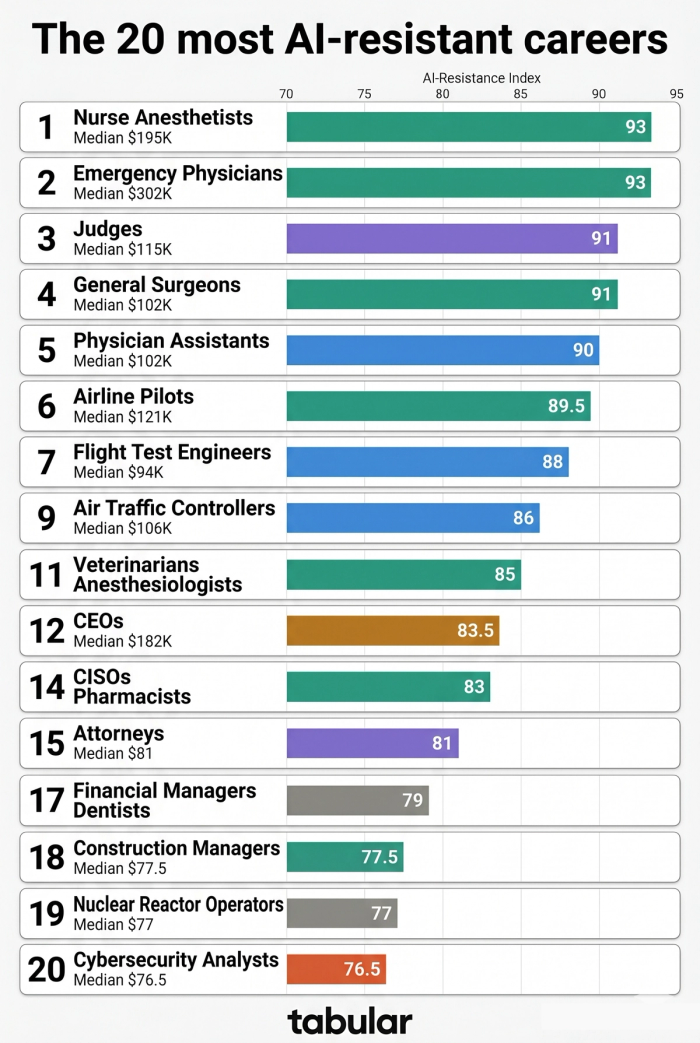
If you're trying to figure out what jobs are safe from AI in the medium-to-long term, two recent pieces of analysis are worth paying attention to. The first is a 20-career index from Resume Now, surfaced through Forbes. The second is a much shorter list from Bill Gates himself — three categories he believes will remain genuinely human-led. They overlap in interesting ways, and disagree in others.
What the data actually says about AI and the workforce
Before getting to the list, the broader picture matters. The AI shift is real and measurable. According to a Morgan Stanley study cited in 3DVF, companies in the UK reported an 8% reduction in workforce linked directly to AI deployments — a striking figure for a mature economy. Microsoft itself flagged 40 roles last year as highly exposed to automation, signaling that routine analysis, document synthesis, and basic support work is already shifting to machines.
But the same reporting points to something subtler: change is uneven. Budgets, regulation, and culture still shape whether a tool replaces, refocuses, or simply nudges a job's boundaries. Microsoft researcher Kiran Tomlinson, in an interview with Sky News' Money team referenced in 3DVF, underscored the point that AI chatbots are best used to boost productivity, not to erase payrolls. That's a useful frame when thinking about what jobs are safe from AI: the most exposed roles aren't necessarily disappearing — they're being rebuilt around the parts of the work AI can't yet do well.
In other words, "what jobs are safe from AI" is the wrong question if you mean "which jobs will exist unchanged." The better question is: which jobs are structurally hard to automate end-to-end?
How the AI-Resistant Careers Index defines a "safe" job
Any honest answer to what jobs are safe from AI has to start with what "safe" means. The AI-Resistant Careers Index from Resume Now, published via Forbes, measures three human skills that automation has consistently struggled to replicate: adaptability, stress tolerance, and self-control. Only positions scoring 74 or higher in all three categories — and offering median salaries of at least $74,000 — made the cut.
The index uses data from the U.S. Department of Labor's O*NET database paired with Payscale salary information. The output is a ranking of 20 careers where human judgment, composure under pressure, and accountability for outcomes are the core of the job — not optional extras.
Here they are.
20 jobs that are safe from AI in 2026
Here's the full list, ranked by Resume Now's AI-Resistant Index. Each entry shows the index score and median salary, with a note on why the role is hard to automate. If you're scanning this to figure out what jobs are safe from AI in your own field, look past the specific titles and notice the common traits — accountability, judgment, and pressure tolerance show up in every single one.
1. Nurse anesthetists — Index 93.3, $195,263
These specialized nurses administer anesthesia and monitor patients during surgical procedures. Split-second decision-making when a patient reacts unexpectedly is the entire job. AI can monitor vital signs, but it cannot replace the nuanced judgment required when a patient's condition suddenly changes.
2. Emergency physicians — Index 92.3, $302,047
Emergency medicine is built around incomplete information and time pressure. ER doctors rapidly assess multiple patients, make life-or-death calls without the luxury of full data, and stay composed in chaos. AI offers diagnostic support, but it cannot replicate the intuition required when minutes matter.
3. Judges — Index 91.3, $115,325
Judges weigh complex evidence, interpret nuanced legal arguments, and maintain absolute emotional control under public scrutiny. AI may assist with legal research, but the wisdom and impartiality required for binding judicial decisions remain uniquely human.
4. General surgeons — Index 91.3, $339,027
Surgeons handle unexpected complications mid-procedure, maintain steady hands under extreme pressure, and make decisions that directly determine patient survival. Robotic surgical tools enhance precision; they don't replace the surgeon's expertise.
5. Commercial pilots — Index 91.0, $101,876
Autopilot handles routine flying. Human pilots are essential for what isn't routine: mechanical failures, weather emergencies, and split-second judgment calls. The job exists because the unexpected exists.
6. Physician assistants — Index 90.0, $112,942
PAs examine patients, diagnose illnesses, and develop treatment plans under physician supervision. AI tools support their work, but the empathy and clinical judgment required when delivering difficult news or working with anxious families don't have an algorithmic shortcut.
7. Airline pilots, copilots, and flight engineers — Index 88.0, $120,510
Aviation crews coordinate during emergencies, adapt to rapidly changing conditions, and maintain absolute focus on long flights. Automation handles the routine. Humans still own the safety call.
8. Flight test engineers — Index 88.0, $100,703
Flight test engineers evaluate aircraft performance and safety through actual test flights. The job demands real-time technical assessment, fast decisions about flight safety, and composure when pushing aircraft to their limits.
9. Air traffic controllers — Index 86.0, $94,241
Controllers manage multiple aircraft simultaneously, adapt instantly to weather changes or emergencies, and maintain composure when lives depend on their decisions. Automation tracks; humans coordinate.
10. Veterinarians — Index 85.0, $106,323
Veterinarians treat patients who cannot communicate symptoms, manage distressed pet owners, and make difficult decisions about animal welfare. The clinical judgment plus compassion combination doesn't translate to software.
11. Anesthesiologists — Index 85.0, $349,293
Anesthesiologists continuously monitor patients, adjust anesthesia in response to changing conditions, and manage life-threatening complications. AI assists with monitoring, but the expertise to keep someone safe through a complex surgery is a human responsibility.
12. Chief executive officers — Index 83.3, $175,380
CEOs navigate uncertain business environments, make decisions affecting thousands of employees, and stay composed under public and shareholder scrutiny. AI provides analysis. Vision and accountability are still on the human leader.
13. Chief information security officers — Index 83.3, $181,751
CISOs adapt to constantly evolving threats, make rapid decisions during active breaches, and lead through crisis. AI enhances cybersecurity capability; strategic security leadership remains a human seat.
14. Pharmacists — Index 83.0, $124,169
Pharmacists adapt to individual patient needs, watch for drug interactions, and manage stressful situations when medication errors occur. Automation can dispense; clinical expertise can't be dispensed.
15. Attorneys and lawyers — Index 80.7, $106,065
Attorneys adapt strategy based on opposing arguments, hold composure during intense courtroom exchanges, and make decisions that shape clients' futures. AI helps with research and document review. Advocacy and judgment are the work itself.
16. Financial managers — Index 78.7, $90,442
Financial managers adapt to market volatility, make high-pressure decisions affecting company resources, and stay composed through crises. AI gives them better analytical tools — and more reason to think clearly with them.
17. Dentists — Index 78.7, $159,970
Dentists adapt procedures to individual patient anatomy, calm anxious patients, and maintain manual dexterity during delicate work. AI assists with diagnostics. Steady hands are still the job.
18. Construction managers — Index 78.0, $88,103
Construction managers handle weather delays, equipment failures, and design changes while leading diverse teams on site. AI plans; humans run the project when reality intervenes.
19. Nuclear power reactor operators — Index 77.7, $74,580
Reactor operators respond instantly to equipment issues, hold focus across long shifts, and stay calm in environments where errors carry catastrophic consequences. The stakes are exactly why the human stays in the loop.
20. Cybersecurity analysts — Index 76.7, $83,244
Cybersecurity analysts adapt to new attack techniques, decide quickly during active incidents, and maintain composure under pressure. AI sharpens detection. Investigation and response remain human work.
The patterns hiding inside the list
A few clear themes surface from the Resume Now index reported by Forbes:
Healthcare dominates. Eight of the 20 positions sit in medicine, all of them combining technical skill with the ability to perform under sustained, life-or-death pressure. AI can support a surgeon or a pharmacist, but it cannot take responsibility for a patient.
Aviation ranks consistently high. Five of the 20 careers are aviation roles. Despite increasingly advanced cockpit automation, flight safety remains human-led — and pay reflects it.
Leadership and oversight resist automation. CEOs, CISOs, and judges combine high-stakes accountability with the emotional regulation that AI cannot replicate. These are jobs where the human part of "human in the loop" is the entire point.
Higher stress correlates with higher pay. Several roles on the list exceed $150,000 annually; surgeons and anesthesiologists clear $300,000. Pressure is being priced into the labor market — and it's being priced up, not down.
The unifying logic is simple. AI is exceptional at pattern recognition over large datasets. It is still poor at improvisation, accountability, and the kind of judgment that requires saying "I made this call, and here's why."
So when someone asks what jobs are safe from AI, the honest answer is: not the ones where the work is mostly producing predictable output from predictable inputs. Those jobs are getting compressed. The ones being protected — and, in many cases, paid more — are the ones where someone has to look at messy, partial, contradictory information and decide what to do next.
Bill Gates' shorter, sharper shortlist
While Resume Now's index focuses on traits, Bill Gates has offered a different lens on the same question — and his answer is much narrower. According to coverage in 3DVF, Gates highlights three professional categories he believes will remain genuinely human-led as AI advances:
- Energy — grid design, dispatch, safety, and crisis response
- Biology — hypothesis formation, lab strategy, and clinical nuance
- Programming and IT — building, debugging, and governing the AI systems themselves
Gates argues, in the 3DVF reporting, that these fields hinge on "complex judgment, creative hypothesis making, and expert oversight of the very systems being deployed." Energy decisions carry physical consequences and ethical trade-offs that resist autopilot. Biology demands original hypotheses and careful experimentation, not just pattern matching across existing literature. And IT remains the scaffolding underneath everything — humans must design, supervise, and secure the AI stack itself, or the whole thing falls apart.
Gates also counsels humility about the future. Past technology waves — industrial automation, the internet — upended expectations and then produced new categories of work nobody predicted. The path ahead isn't predetermined. As he frames it in the 3DVF coverage, the durable bet is on "human judgment steering powerful tools, not the other way around — at least for now."
That last clause is doing a lot of work. Gates isn't claiming any job is permanently safe. He's claiming a few categories are currently hard to automate end-to-end, and that the people inside those fields have time to keep adapting. So when he answers what jobs are safe from AI, he's really answering what jobs are safe for now — and signaling that the answer will keep shifting.
Transformation, not elimination — what the data actually means for your job
Reading the index alongside Gates' shortlist, the message is less extinction than remix. The honest answer to what jobs are safe from AI in the future is: most of them will exist, but most of them will look different. Tasks are being reshuffled across virtually every white-collar job. Titles endure; the work inside them changes.
Microsoft's Kiran Tomlinson framed it directly in the 3DVF reporting: AI chatbots are most useful when they boost productivity, not when companies use them to erase payrolls. The most durable workers in this transition are the ones who treat AI as a colleague that never tires but still needs direction, critique, and context.
Three skills carry across almost every role on the index:
- Adaptability — the willingness to use a tool you didn't have last quarter, and the discipline to stop using it when something better shows up.
- Judgment under uncertainty — the ability to make a call when the data is incomplete, and the comfort with being accountable for it afterward.
- Communication — the human skill of taking an output (from a model, a database, a colleague, a customer) and turning it into a decision someone else can act on.
Notice how those three apply just as cleanly to a marketing manager as to an emergency physician. The careers that top Resume Now's index simply have those skills embedded into the job description more obviously than most. So the deeper answer to what jobs are safe from AI is less about specific titles and more about how much of your current role is built around those three traits.
For roles outside the top 20, the practical takeaway from both Forbes and 3DVF is the same: when you're trying to figure out what jobs are safe from AI, the careers most exposed to automation are the ones built around routine output. The careers least exposed are the ones built around responsibility for outcomes.
Frequently asked questions about what jobs are safe from AI
What jobs are safe from AI in the future according to current research? The most rigorous public dataset is Resume Now's AI-Resistant Careers Index, reported in Forbes, which scored jobs on adaptability, stress tolerance, and self-control. The 20 careers above — led by nurse anesthetists, emergency physicians, and judges — top the list. Bill Gates, in 3DVF's coverage, narrows it further to three categories: energy, biology, and programming/IT.
Are creative jobs safe from AI? Less than people assumed two years ago. Generative AI now produces credible drafts in writing, design, music, and video. Creative roles that survive the shift are the ones built around editorial judgment, taste, and accountability for the final product — not the ones built around producing volume.
Will AI replace knowledge workers entirely? The Microsoft research perspective from Kiran Tomlinson — referenced in 3DVF — pushes back on the "replacement" framing. AI is most useful when it boosts a knowledge worker's productivity, not when it tries to do the worker's job whole. Knowledge workers who treat AI as a colleague that needs direction outlast the ones who treat it as a threat.
What skills make a job AI-resistant? The Resume Now index measures three: adaptability, stress tolerance, and self-control. Across the 20 careers identified by Forbes, those traits show up as the ability to make a call without complete information, the composure to do it under pressure, and the willingness to be accountable for the outcome. If you're auditing your own role to figure out what jobs are safe from AI from the inside, those three traits are the test.
Is email marketing safe from AI? Not in the sense that AI won't touch it — AI already drafts subject lines, copy, and segmentation logic. But the channel itself is structurally durable for the same reasons the top careers are: it requires human judgment about what to send to whom, it lives on a permission-based relationship that can't be automated, and the sender stays accountable for the result.
Where email — and direct human communication — still wins
This is where the conversation gets specifically interesting for anyone reading from a marketing, communication, or business background.
Generative AI is now extremely good at producing copy. Drafts of emails, captions, blog intros, support replies — a model will give you a workable version in seconds. So a fair question is: if AI can write the message, why does writing it still matter?
Because the message isn't the value. The relationship the message lives inside of is the value.
Email remains the most durable direct-communication channel a business has, for three reasons that map cleanly onto the patterns in the AI-Resistant Careers Index.
Email is judgment-driven, not output-driven. A model can generate ten variants of a subject line in a second. Deciding which one fits your audience this week — knowing they just got a separate launch announcement, or that the last campaign underperformed because of weather, or that the segment you're sending to skews skeptical — is judgment. That's the same human-judgment skill that keeps surgeons, judges, and CEOs on the index. AI accelerates the drafting; the call on what to actually send stays with you. Tabular's past and future of email digs into why this is structurally true.
Email is a permission asset. Your subscriber list is one of the few marketing channels you actually own. Search algorithms change overnight. Social platforms throttle reach. Ad costs swing on factors you don't control. An email list — built on opt-in, owned by you, deliverable directly — sidesteps all of that. AI can help you write to that list more efficiently. It cannot build the trust that earned you the right to land in those inboxes in the first place. (The importance of email marketing makes this case in detail, with the channel-by-channel ROI comparison.)
Email is accountable. When you send an email, your name (or your company's name) is at the top of it. If the message lands wrong, you wear it. That accountability — the same trait running through every role on Resume Now's list — is what makes email feel different from a model-generated tweet or an algorithmic ad. The reader knows there's a human at the other end who decided this was worth their time.
The careers safest from AI are not the ones that resist using AI. They're the ones where humans take responsibility for the call. Email marketing fits the same pattern. AI can draft your next newsletter in 15 seconds. Whether you send it, what it says, who it goes to, and what happens after they reply — that's your job. And that's the part that's holding up just fine.
Put differently: when people ask what jobs are safe from AI, they often imagine a binary — either AI does the job or you do. The reality across every career on the index, and every communication channel that's still working, is collaborative. The human decides; the tool accelerates. Email, run well, is exactly that pattern at the channel level.
For a sense of how the channel is performing right now, the latest email marketing stats capture where opens, clicks, and ROI sit in 2026. Spoiler: email is not slowing down. If your career is in email or marketing communications, the answer to what jobs are safe from AI in your field is the same as everywhere else on this list — the jobs built on judgment, accountability, and direct relationships with the audience.
The takeaway
If your goal in reading this was figuring out what jobs are safe from AI for your own career planning, the practical answer is layered. The 20 careers on Resume Now's AI-Resistant Careers Index — from nurse anesthetists at the top to cybersecurity analysts at the bottom — share a common spine: human judgment, composure under pressure, and accountability for outcomes. Bill Gates' shorter list of energy, biology, and programming names a similar spine from a different angle. Both lists agree that the safest jobs are not the ones AI can't touch — they're the ones where humans must own the decision.
The same logic applies to communication channels. AI is going to keep getting better at generating words. Email is going to keep being the place where humans decide which words actually go to which people, and stand behind the result. Whatever your job title is, the durable skills are the same ones the index measures: adaptability, judgment, and the willingness to be accountable for what you put your name on.
Pick a career — or a channel — built on those, and you'll outlast the next wave just like the previous waves got outlasted before it. The honest answer to what jobs are safe from AI isn't a static list. It's a moving target, defined by how willing you are to keep owning the decisions only you can make.