
Two-Week Notice Email Templates: 8 Copy-Paste Examples for Every Situation
You've made the decision to leave your job — now you have to actually tell someone. If you're staring at a blank compose window wondering how to word your two-week notice email, you're not alone. Most people spend far more time agonizing over what to write than the email actually warrants.
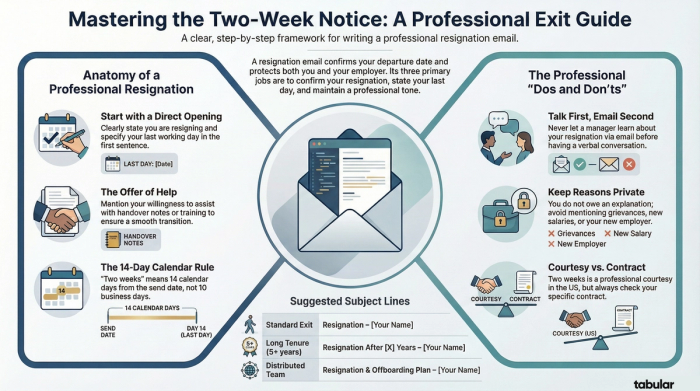
Here's the reassuring part: a two-week notice email doesn't need to be complicated. It has exactly three jobs — confirm that you're resigning, state your last working day, and keep things professional. That's it.
A two-week notice email is a formal message sent to your employer stating your intention to resign, with your last working day set two weeks from the date you send it. It serves as a dated, written record that protects both you and your employer.
In this guide, you'll find eight ready-to-copy templates for different situations, a breakdown of what to include (and what to leave out), and answers to the questions people actually search at 11 pm the night before handing in their notice. If you haven't settled on the right tone yet, our email writing format guide covers the structural basics of professional emails.
What Is a Two-Week Notice Email?
A two-week notice email is a formal message — sometimes called a resignation email — that informs your employer you're leaving your position. You send it to your direct manager (and typically CC human resources) with a clearly stated last working day, set 14 calendar days from the date of the email.
The purpose is straightforward: it creates a paper trail. Your manager needs it for planning, HR needs it for payroll and offboarding, and you need it in case there's ever a dispute about your departure date or the terms of your exit.
Is two weeks' notice legally required? In the United States, most employment is at-will, which means you can resign at any time without owing a specific notice period. Two weeks is a professional courtesy — not a legal obligation. That said, some employment contracts and employee handbooks do specify a required notice period, so it's worth checking yours before you send anything.
Why send an email instead of just telling your manager? The email is the formal record. A verbal conversation is the respectful first step (and you should always have one before the email goes out), but a conversation alone doesn't give HR a dated document to process. Best practice is to speak with your manager in person or on a call first, then send the email the same day as the official written notice. Never let your manager learn you're leaving from an email they weren't expecting.
Understanding the parts of an email — subject line, greeting, body, sign-off — can help you structure your notice clearly and avoid awkward formatting.
What to Include in a Two-Week Notice Email
A strong resignation email is short, clear, and impossible to misread. Every two-week notice email should contain these five elements:
A clear subject line. Your manager should know immediately what this email is about. Use something direct like "Resignation – [Your Name]" or "Two Weeks Notice – [Your Name], [Job Title]." Avoid vague phrasing.
A direct opening statement. Don't bury the news. Your first sentence should state that you are resigning and what your last day will be. Everything else is secondary.
A brief, specific thank you. One or two sentences acknowledging something you genuinely valued — a project you worked on, a skill you developed, the team culture. Keep it sincere but short. A generic "thank you for everything" is fine if you can't think of anything specific; just don't overdo it.
An offer to help with the transition. Mention that you're happy to assist with handover notes, training your replacement, or wrapping up open work. This single line costs you nothing and can pay off significantly when you need a reference later.
A professional sign-off with contact details. Include your personal email address or LinkedIn so the relationship can continue once your company email is deactivated. For more ideas on closing your email well, see our guide to the best email sign-offs.
What to leave out: Your reasons for leaving (you don't owe an explanation), the name of your new employer, your new salary, and any grievances. As a general rule, don't write anything you wouldn't want read aloud in an HR meeting two years from now.
8 Two-Week Notice Email Templates
Below are eight templates covering the most common resignation scenarios. Each includes a subject line, a full copy-paste email body, a note on when to use it, and a tip on what to customise.
Template 1: Standard Professional Two-Week Notice
Subject: Resignation – [Your Name]
Dear [Manager's Name],
I'm writing to formally notify you of my resignation from my position as [Job Title] at [Company Name]. My last working day will be [Date — 14 calendar days from today].
I'm grateful for the opportunities I've had here, particularly [specific project, skill, or experience]. Working with this team has been a genuinely positive chapter in my career.
I'm happy to help make the transition as smooth as possible over the next two weeks — whether that means documenting my current projects, training a colleague, or wrapping up open tasks.
Thank you for your support during my time here. I'd love to stay in touch — you can reach me at [personal email] or connect with me on [LinkedIn URL].
Best regards, [Your Name]
Use this when: You're leaving on good terms in a standard, professional environment. This is the workhorse template — suitable for the vast majority of situations.
Customise: Replace the bracketed project reference with something specific to your role.
Template 2: Two-Week Notice to a Manager You're Close To
Subject: Resignation – [Your Name]
Hi [Manager's First Name],
This isn't an easy email to write. I wanted to let you know that I've decided to resign from my role as [Job Title], with my last day being [Date].
I want you to know how much I've valued working with you. Your mentorship on [specific example] genuinely shaped the way I approach [skill or area]. I wouldn't be where I am professionally without that guidance.
I'll do everything I can to make the next two weeks as productive as possible for the team. I'm also very much hoping we'll stay in touch — you can always reach me at [personal email].
With real gratitude, [Your Name]
Use this when: You have a strong, positive working relationship with your direct manager and want the email to reflect that warmth.
Customise: The mentorship reference. Be specific — vague praise reads as generic.
Template 3: Two-Week Notice After a Short Tenure (Under 1 Year)
Subject: Resignation – [Your Name]
Dear [Manager's Name],
I'm writing to let you know that I've decided to resign from my role as [Job Title]. My last working day will be [Date].
Although my time at [Company Name] has been relatively short, I've appreciated the opportunity to contribute to [specific project or team goal]. I've learned a great deal in a condensed period.
I want to ensure a smooth handover during my remaining time and am happy to document my work or brief a colleague on anything outstanding.
Thank you for the opportunity. Please feel free to reach me at [personal email] going forward.
Kind regards, [Your Name]
Use this when: You've been in the role for less than a year. This template acknowledges the short tenure without over-explaining or apologising.
Customise: The specific project reference to show that your contribution, however brief, was meaningful.
Template 4: Two-Week Notice After a Long Tenure (5+ Years)
Subject: Resignation – [Your Name]
Dear [Manager's Name],
After [number] years at [Company Name], I've made the difficult decision to move on. I'm formally submitting my resignation, with my last working day being [Date].
It's hard to condense [number] years into a few sentences, but this role has been foundational for me. I've grown from [earlier role or responsibility] to [current scope], and much of that growth is down to the team and leadership here. I'm especially grateful for [one or two specific things — a promotion, a project, a mentor].
Given my tenure, I want to make sure the transition is as thorough as possible. I'm committed to spending my remaining weeks documenting processes, transitioning responsibilities, and supporting the team in any way that's helpful.
I'd love to keep this relationship going. You can reach me at [personal email] or [LinkedIn URL] any time.
With sincere appreciation, [Your Name]
Use this when: You've spent a significant portion of your career at this company. A slightly longer, more reflective tone is appropriate here.
Customise: The growth arc. Be specific about how you evolved — it reinforces the genuine connection to the role.
Template 5: Two-Week Notice With an Offer to Extend
Subject: Resignation – [Your Name]
Dear [Manager's Name],
I'm writing to formally resign from my position as [Job Title] at [Company Name]. My intended last day is [Date — 14 calendar days from today].
That said, I understand that transitions can be complex, and I want to be flexible. If a slightly longer handover period would be genuinely helpful for the team, I'm open to discussing an adjusted timeline.
In the meantime, I'll prioritise wrapping up [key project or responsibility] and making sure everything is documented for whoever takes over.
Thank you for a great experience. I can be reached at [personal email] after my departure.
Best regards, [Your Name]
Use this when: You're leaving on excellent terms and are genuinely willing (and able) to stay a bit longer if needed. Don't offer this if you don't mean it.
Customise: Be honest about what you can offer. If your new start date is fixed, don't promise flexibility you can't deliver.
Template 6: Two-Week Notice for a Difficult Workplace
Subject: Resignation – [Your Name], [Job Title]
Dear [Manager's Name],
Please accept this email as formal notification that I am resigning from my position as [Job Title] at [Company Name], effective [Date].
I will ensure all outstanding work is completed or handed over during my notice period. Please let me know how you'd like to handle the transition.
Thank you for the experience. I can be reached at [personal email] for any follow-up matters.
Regards, [Your Name]
Use this when: The work environment was toxic, hostile, or simply unpleasant — and you want to resign without burning any bridges or revealing how you feel. This template is professional to the point of neutrality. It protects your references while sharing nothing personal.
Customise: Nothing. The brevity is intentional. If you feel compelled to add more, resist the urge.
Template 7: Two-Week Notice for a Remote or Distributed Role
Subject: Resignation – [Your Name]
Hi [Manager's Name],
I'm writing to formally resign from my remote position as [Job Title] at [Company Name]. My last working day will be [Date].
Since we work distributed, I want to flag a few logistics:
Thank you for the flexibility and trust that comes with remote work here. It's been a genuinely good experience. You can reach me at [personal email] going forward.
Best, [Your Name]
- I'll prepare written handover documentation for all active projects and shared drives.
- I'm available for offboarding calls with the team during my final two weeks — just let me know what works.
- I'll return any company equipment (laptop, monitor, etc.) via the process outlined in the employee handbook, or please let me know if there's a preferred shipping method.
Use this when: You work remotely or in a distributed team and need to address logistics that in-office employees don't typically think about — equipment returns, async handovers, and virtual offboarding.
Customise: The logistics list based on your company's remote work policies.
Template 8: Two-Week Notice During Probation
Subject: Resignation – [Your Name]
Dear [Manager's Name],
I'm writing to inform you of my decision to resign from my role as [Job Title] at [Company Name]. Per my probationary terms, my last working day will be [Date — check your contract for the applicable notice period; it may be shorter than two weeks].
I appreciate the opportunity to have joined the team, and I wish you and the company continued success.
I'll make sure any work in progress is documented and handed off before my departure. Please don't hesitate to reach out at [personal email] if needed.
Kind regards, [Your Name]
Use this when: You're still within your probation period. Notice requirements during probation are often shorter (sometimes one week), so check your contract before setting the date.
Customise: The last-day date — verify your contractual notice period rather than defaulting to 14 days.
Two-Week Notice Email Subject Lines
Your subject line should leave zero ambiguity. Your manager should know what the email is about before opening it. Here are ten ready-to-use subject lines, each suited to a slightly different context:
Formal and standard: "Resignation – [Full Name]" — works in any situation and is the safest default.
With job title for clarity: "Two Weeks Notice – [Name], [Job Title]" — useful in larger organisations where your manager oversees many direct reports.
Warm but professional: "Moving On – Resignation Notice from [Name]" — slightly softer, appropriate when you're close to your manager.
Short tenure: "Resignation Notice – [Name]" — neutral tone that doesn't draw attention to how long you've been there.
Long tenure: "Resignation After [X] Years – [Name]" — acknowledges the significance of the departure.
During probation: "Notice of Resignation – [Name], Probation Period" — makes the contractual context clear upfront.
Remote role: "Resignation & Offboarding Plan – [Name]" — signals that you've thought about the logistics.
Extended notice offer: "Resignation – [Name] (Open to Extended Transition)" — flags your flexibility in the subject.
What to avoid in subject lines: Negative language ("I quit"), reasons for leaving ("Found a better job"), clever phrasing that obscures the purpose, and the name of your next employer. Keep it professional and clear. If you want more guidance on writing effective subject lines, our email greetings and email copywriting guides cover the principles in depth.
Common Two-Week Notice Mistakes to Avoid
Even a short email can go wrong if you overlook a few key details. Here are six mistakes that are surprisingly common — and easy to prevent.
Sending the email before having the conversation. Your manager should never find out you're resigning by reading an email. Always have the conversation first — in person, over a video call, or at minimum by phone — and then send the email the same day as the formal written record. The email confirms what was already discussed; it doesn't deliver the news.
Miscalculating your last day. "Two weeks" means 14 calendar days from the date you send the notice, not 10 business days. If you send your email on a Monday, your last day is the Monday two weeks later — not the following Friday. When in doubt, count the days on a calendar and state the exact date in the email so there's no room for confusion.
Over-explaining why you're leaving. You don't owe your employer a detailed reason. A line like "I've decided to pursue a new opportunity" is sufficient and professional. Getting specific — especially about things you disliked — opens doors you're better off leaving closed. The less you say about your reasons, the less there is to misinterpret.
Overpromising on the handover. Offering to help with the transition is good etiquette, but only commit to what you can realistically accomplish in two weeks. Promising to train your replacement, document every process, and close all open projects is a recipe for resentment on both sides. Be specific about what you'll prioritise.
Burning bridges in the sign-off. Even if the job was miserable, this email may surface in a background check or reference request years down the line. Bland is always better than bitter. Save the venting for a trusted friend, not a company email server.
Forgetting to CC HR. In most organisations, the resignation email should go to your direct manager with a copy to HR (or the people team). HR needs the record for payroll, benefits, and offboarding. If you're unsure whether to CC or BCC, ask your manager during the initial conversation.
If you're planning your exit thoroughly, you might also want to prepare your last working day goodbye email — a separate message to the broader team on your final day.
FAQs
Can I give two weeks' notice by email? Yes. Email is the standard and preferred method in most modern workplaces. It creates a dated, written record that both you and your employer can reference. The key is to have a verbal conversation with your manager first and then follow up with the email as the formal record.
What if my employer asks me to leave immediately? This is more common than people expect, especially in certain industries. If you're asked to leave on the spot, you may still be entitled to pay for the full notice period depending on your contract and local employment law. Review your employment agreement and, if you're unsure, consult an employment attorney.
Should I give more than two weeks' notice? Only if you genuinely want to and your contract doesn't already specify a longer period. In most cases, two weeks is sufficient. Extending your notice period can sometimes prolong an awkward transition rather than help — particularly if your manager starts treating you differently once they know you're leaving.
Do I need to give a reason for leaving in the email? No. "I have decided to move on to a new opportunity" is entirely sufficient. You're not obligated to share where you're going, why you're going, or what you'll be earning. If your manager asks in conversation, you can share as much or as little as you're comfortable with — but the email itself needs no explanation.
What if I'm still in my probation period? Your notice period during probation is often shorter than the standard two weeks — commonly one week, though it varies by contract. Check your employment agreement for the specific terms. Template 8 above is written for exactly this scenario.
Can my employer refuse to accept my resignation? In at-will employment (which covers most US workers), no. A resignation is a unilateral decision — you don't need your employer's consent to leave. For contract-based roles, the terms of your agreement will specify the process, but even then, an employer can rarely force you to stay.
Wrapping Up
A two-week notice email comes down to three things: state that you're leaving, be clear about your last day, and keep the tone professional regardless of how you feel about the job. Choose the template that matches your situation, customise the bracketed sections, and hit send.
If you're now thinking about the next steps — setting up your out-of-office, preparing for interviews at your new role, or drafting a goodbye note for your last day — these guides will help:
- Thank you email after an interview — for when you're wrapping up your job search at the new company.
- Last working day email to say goodbye — for the farewell message to your broader team.
- How to send a resume by email — if you're still exploring roles and need to get your CV across professionally.
- Sick leave email templates — handy workplace email templates for other common situations.