
How to Make Money From Newsletters: Real Numbers and Case Studies
Table of contents
- First: Why Newsletters Are Worth Taking Seriously
- The Three Fundamental Ways Newsletters Make Money
- The Main Revenue Models in Detail
- The Economics Nobody Talks About Honestly
- Deciding Your Monetization Model Before You Start
- The Role of Email Design in Newsletter Revenue
- A Practical Roadmap by Stage
- What Actually Separates Successful Newsletter Operators
- The Bottom Line
- FAQ
Newsletters are one of the most talked-about business models on the internet right now. You have probably seen the tweets, the LinkedIn posts, the Reddit threads — people claiming to earn six or seven figures by sending emails a few times a week. Some of it is true. A lot of it is hype. And the gap between the two is exactly where most aspiring newsletter operators get lost. Let's learn the whole truth about how to make money from a newsletters.
This guide is not here to sell you a dream. It is here to give you a clear, practical picture of how newsletters generate revenue, what the economics actually look like at different stages, what the real conversion rates and subscriber thresholds are, and how to think about your monetization strategy before you write a single word. We will look at real operators, real numbers, and the honest trade-offs of each approach.
First: Why Newsletters Are Worth Taking Seriously
Before getting into the money mechanics, it is worth understanding why newsletters have become such an attractive business in the first place.
Unlike social media, you own your email list. Algorithm changes on Instagram, TikTok, or LinkedIn can reduce your reach overnight. Your email list cannot be taken away from you. This is a meaningful structural advantage. It also explains why email marketing consistently shows a return on investment that dwarfs most other digital channels — research puts the average ROI for email marketing at around 3,600%, meaning for every dollar invested, you can reasonably expect around $36 back.
Newsletters also benefit from being a direct, personal channel. Academic research from 2022 found that email holds roughly a 22% average open rate, which is significantly higher than the engagement rates most content formats can achieve. You are landing directly in someone's inbox, a space they have chosen to give you access to.
That said, newsletters are not a magic business. They are a media business, which means they require consistent output, a well-defined audience, patience, and a monetization strategy that actually fits the size and nature of your list. People who treat newsletters as passive income tend to fail. People who treat them as a content-first business with multiple revenue levers tend to build something durable.
The Three Fundamental Ways Newsletters Make Money
Before breaking down specific strategies, it helps to understand that all newsletter revenue falls into one of three buckets.
The first is advertising and sponsorships, where third parties pay to reach your audience. This requires scale — typically a minimum of 20,000 active subscribers before you have genuine leverage with advertisers — and it requires either strong sales skills or an ad network intermediary.
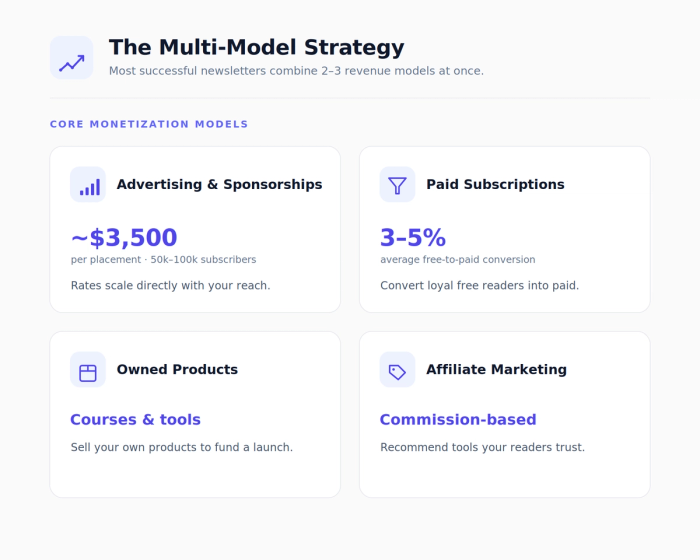
The second is subscriptions and paywalled content, where readers pay you directly for access. This can work with a much smaller audience, but only if your content is genuinely irreplaceable. Very few newsletters convert more than 15% of their free list to paid, and typical conversion rates are closer to 3–5%.
The third is using the newsletter as a lead channel for something else — a course, a service, a community, a product. Here the newsletter itself is not the revenue source; it is the distribution engine. This is arguably the most overlooked model, and for many operators, the most financially sensible one.
Every specific tactic you will read about below falls into one of these three categories. Understanding which category you are operating in changes how you build your content strategy, how you grow your list, and what your economics look like.
The Main Revenue Models in Detail
1. Advertising and Sponsorships
Sponsorships are the most visible newsletter revenue model because the big newsletters — Morning Brew, The Hustle, Bay Area Times — built their businesses on it. The mechanics are simple: a brand pays you to place an advertisement, a sponsored section, or an advertorial piece inside your newsletter.
Sponsorships come in a few formats. The most common is a main placement or "primary ad" at the top or near the top of a newsletter issue, usually including a headline, short copy, an image, and a call to action. This commands the highest rates. Secondary or tertiary placements sit lower in the email and are priced accordingly. Then there are advertorials — full editorial pieces written about a sponsor's product or company. These are longer, more integrated, and significantly more expensive than standard placements.
The physical design of these placements inside your email matters more than most new operators realize. Sponsors are paying for a professional-looking ad in a professional-looking newsletter. A poorly formatted placement — broken image, misaligned CTA button, inconsistent fonts — undermines the perceived value of the ad slot and makes sponsors less likely to rebook. Building your newsletter templates with dedicated, reusable ad placement blocks is the right approach from day one. Tabular lets you save sponsor placement sections as design components in your template library, so every issue has a consistent, polished ad format that you can update in seconds without touching the surrounding editorial layout.
Create Custom Newsletters with Tabular's Email Builder
Pricing is typically based on CPM (cost per thousand subscribers) or a flat rate per issue. At 50,000 to 100,000 subscribers, you can realistically charge around $3,500 per main placement. At smaller sizes, rates are lower. Packy McCormick of Not Boring — who writes detailed breakdowns of how technology and business intersect — built a sponsorship business estimated at around $4 million in annual revenue at roughly 183,000 subscribers, combining main placement ads at roughly $25,000 each with long-form advertorial pieces at over $100,000 each. Those numbers are exceptional. For a more typical newsletter with 30,000 subscribers, realistic ad revenue might be $10,000–$20,000 per month if you are sending consistently and selling effectively.
The honest trade-off with sponsorships is that they are audience-dependent and require ongoing sales work. If your open rate drops, your CPM drops. If you have a bad month for subscriber growth, sponsors notice. You are perpetually in a cycle of selling and delivering. It also requires either significant list size or a very valuable niche audience. A newsletter about securities law with 8,000 highly engaged readers in financial services might command premium sponsorship rates that a general personal finance newsletter with 80,000 casual readers cannot.
What you need to make ads work: A list of at least 15,000–20,000 active subscribers is a reasonable floor for direct sponsorship deals. Below that, ad networks can help fill inventory, but rates will be low. You also need a consistent send cadence — sponsors want predictability — and an open rate above 30% to be taken seriously by quality advertisers.
2. Paid Subscriptions and Paywalled Content
The paid subscription model is the purest form of newsletter monetization: readers pay you directly because your content is worth paying for. No advertisers, no middlemen, no dependency on list size for revenue (though list size still matters for growth).
The most instructive case study here is Lenny Rachitsky, who started his product management newsletter in 2019 and added a paid tier in 2020. His paid subscription runs at $15 per month, and with roughly 19,000 paid subscribers, that works out to around $3.5 million per year from subscriptions alone — not counting his podcast, events, job board, or swag store, which he has suggested roughly doubles the total. Ben Thompson's Stratechery, which focuses on technology strategy and has been running since 2013, is estimated to have 40,000–50,000 paid subscribers, putting it well above $5 million in annual revenue.
At the extreme end is Kevin Van Trump of The Van Trump Report, who covers agricultural markets. Van Trump has around 30,000 subscribers but charges $60 per month — four times what Lenny charges. The result is approximately $20 million in annual revenue from a relatively modest subscriber base. The lesson is that price is a function of value density and audience willingness to pay, not just subscriber count.
These numbers are inspiring, but they require honest context. Each of these operators had significant advantages — Lenny had a high-profile career at Airbnb and invested in 150+ startups; Ben Thompson spent years as a respected tech analyst; Kevin Van Trump serves a professional audience of farmers who depend on his market intelligence to make financial decisions. The content they produce is either irreplaceable or comes from a uniquely credible source.
For a new newsletter operator, the subscription model is viable but slow. The typical free-to-paid conversion rate is 3–5%. That means with 5,000 free subscribers, you might have 150–250 paying. At $10 per month, that is $1,500–$2,500 per month. Meaningful, but not a full-time income on its own. To reach full-time income levels purely through subscriptions, most operators need either a large free list, a premium price point with a high-value niche, or both.
The key strategic question for subscriptions is whether your content can survive a paywall. The moment you restrict access, you are asking readers to make a commercial judgment about value. Lenny's content was so specifically useful to product managers and founders that thousands chose to pay. A general curiosity newsletter rarely clears that bar. Before adding a paywall, one practical benchmark is to wait until you have at least 500 free subscribers and a track record of strong engagement — above 40% open rates and 2%+ click rates. Even then, build slowly. Many operators start with a hybrid model where some content is free and a premium tier unlocks additional access, rather than locking everything behind a paywall from day one.
What you need to make subscriptions work: Genuinely irreplaceable content in a niche where your audience has professional or financial motivation to stay informed. Strong engagement metrics (40%+ open rate) before you introduce paid tiers. A price point that reflects the actual value — do not undercharge if your audience is professional.
3. Selling Your Own Products
This is where the newsletter operates as a distribution engine rather than a media business. You build an audience around a topic you know deeply, and then you sell them a product — a course, a guide, templates, a community, a coaching package — that delivers more structured value than the free newsletter can.
The economics here are compelling. Unlike advertising, where you need scale and ongoing sales cycles, a well-executed product launch to even a small engaged list can generate significant revenue. One creator with around 3,000 subscribers sold a course on Canva templates during launch and made close to $8,000. That same course has since crossed $167,000 in total revenue, largely driven by the newsletter. Tom Alder of Strategy Breakdowns, with 55,000 subscribers, launched StrategyHub — a career course for product and strategy professionals — and reportedly generated over $100,000 on launch alone. The newsletter's welcome sequence and automated follow-ups continue to drive ongoing course sales without additional effort.
The range of products operators sell through newsletters includes online courses (high-margin, scalable, work best with a teaching-oriented newsletter), digital products like templates, guides, and workbooks (lower price point, high volume), coaching or consulting services (high price, non-scalable but very high margin), community memberships (recurring revenue, builds loyalty), and physical products (harder to scale but can be extremely brand-reinforcing when tied to a strong community).
The mechanics of actually selling to your list depend heavily on how your emails are structured. A welcome sequence that introduces a new subscriber to your best content and then surfaces your product needs clean, readable templates with clear CTAs at the right moments. Personalization helps considerably — addressing subscribers by name and showing different content to different audience segments (engaged readers versus new arrivals, for example) increases conversion rates meaningfully. Tabular's email builder supports dynamic content blocks with conditional rules, so you can build one template that shows different product pitches to different segments without creating separate email files for each variation.
The key insight about product-based monetization is that it requires your newsletter to be positioned as educational or expertise-driven from the beginning. If your newsletter's value proposition is curation or entertainment, selling a course is a jarring pivot. If it is consistently teaching your readers something, selling a deeper product feels like a natural next step.
What you need to make owned products work: A content positioning that establishes you as an expert. A reasonable list size — even 2,000–5,000 engaged subscribers can support a meaningful product launch. A price point that reflects genuine transformation. An evergreen sales mechanism (welcome sequence, automated follow-ups) so you are not dependent on periodic launches.
4. Affiliate Marketing
Affiliate marketing means embedding trackable links to third-party products in your newsletter and earning a commission when readers purchase. It is the lowest-friction revenue model to start — no sales calls, no product creation — but it is also the lowest margin and the hardest to scale.
The economics of affiliate marketing in newsletters are modest unless you are in a high-value niche. Promoting a $19 ebook to a list of 25,000 subscribers might result in 500 purchases at a 2% conversion rate, generating $9,500 in revenue — but you keep only a fraction of that as your commission. In B2B niches, where products can cost $5,000–$10,000 and commissions are 10–20%, the math improves significantly. A single affiliate placement for a high-ticket B2B software product in a relevant newsletter can earn more than a dozen consumer affiliate placements.
The real risk with affiliate marketing is audience trust. Readers understand that recommendations in a newsletter might be motivated by commission. If every issue contains affiliate links to loosely relevant products, readers stop trusting your recommendations. The most effective affiliate newsletter operators are ruthlessly selective — they only recommend products they have actually used, they are transparent about the affiliate relationship, and they treat the affiliate placement as a recommendation, not an advertisement.
What you need to make affiliate marketing work: A niche where high-value products exist (B2B, professional services, financial tools tend to work better than consumer goods). Genuine familiarity with the products you recommend. Restraint — too many affiliate links too often erodes trust faster than it builds revenue.
5. Events and Community
This is a less common but genuinely lucrative model for operators who can sustain it. Kevin Van Trump, beyond his paid newsletter, created FarmCon — an annual conference for thousands of farmers — and Ag Swag, a branded merchandise company serving agricultural businesses. Both grew directly from the credibility and community he built through his newsletter.
Lenny Rachitsky's paid subscriber Slack community, with nearly 20,000 members, is itself a product — a place where product managers can connect with peers and mentors. The Generalist, Indie Hackers, and other newsletter-adjacent communities have built sustainable revenue through membership-based access to curated professional networks.
Events and community are high engagement and high loyalty models, but they are also high time commitment. Running a conference is a logistics business. Managing an active community requires moderation, programming, and ongoing investment. These models work best when the newsletter has already built a tight, professionally aligned audience that has a genuine motivation to connect with each other.
6. Investment Syndicates and Funds
This model is niche but noteworthy because of the revenue potential. Packy McCormick of Not Boring built an investment fund — Not Boring Capital — directly from his newsletter audience. Fund III raised $30 million with a cap at $50 million. Under a standard 2/20 venture capital structure, that generates $600,000–$1,000,000 per year in management fees before any carried interest on successful exits.
The Generalist operates a similar structure through Generalist Capital. Last Money In, a newsletter with just 41,000 subscribers, runs Deal Sheet — a paid access product to curated deal flow across investment syndicates — generating $500,000 in annual recurring revenue, plus $200,000 in ad revenue.
This model requires deep credibility in investment topics, a relevant and financially sophisticated audience, and significant regulatory and legal infrastructure. It is not a beginner model. But it illustrates the ceiling that newsletter media can reach when the operator's expertise and audience trust are genuinely exceptional.
7. Acquisition
Your newsletter is an asset. If you build it to a point of consistent revenue generation, other people will pay to own it. Newsletter acquisitions happen at multiples of annual revenue, typically 2–4x for smaller newsletters and higher for those with strong growth trajectories or valuable audiences.
The practical implication is that if you build a newsletter generating $5,000 per month in consistent revenue, it is worth somewhere between $120,000 and $240,000 as an acquisition target. Some operators build newsletters deliberately with exit in mind, focusing on clean financials, documented processes, and transferable audience relationships. Others stumble into acquisition conversations once their newsletter becomes visible enough.
The Economics Nobody Talks About Honestly
Most newsletter content online focuses on the upside. Here is what the numbers actually look like for most operators.
Conversion rates are low. The absolute best free-to-paid conversion rates in the newsletter industry are just over 10%. More typical is 3–5%. If you have 10,000 free subscribers and charge $10 per month with a 3% conversion rate, your monthly subscription revenue is $3,000. That is meaningful but not full-time income in most cities.
Ad revenue requires real scale. Until you have roughly 20,000 active subscribers, you are unlikely to build a sustainable ad business. Below that threshold, direct sponsor relationships are difficult to establish, and ad network CPMs will be low. The math at smaller sizes often does not justify the time spent on sales.
Timeline is longer than most sources admit. The average content creator earns their first dollar from their newsletter after about 6.5 months. By 17–18 months, the average is earning enough to cover basic living expenses. Full-time income typically comes around the two-year mark, for those who are consistent and strategic. This is not discouraging — it is actually faster than building most businesses — but it is not the six-months-to-riches story that circulates on social media.
List health matters more than list size. A small, engaged list consistently outperforms a large stale one. A newsletter with 5,000 subscribers and a 45% open rate will generate more meaningful revenue than one with 50,000 subscribers and a 10% open rate. The minimum benchmarks for a healthy list are an open rate above 40% and a click rate above 2%. Below these numbers, your monetization options narrow dramatically. Click rate in particular is a design problem as much as a content problem — a CTA buried in a wall of text with no visual breathing room around it will underperform the same offer presented in a clean, well-spaced layout with a clearly styled button. Tabular's email builder is built around the principle that layout drives engagement: white space, mobile-responsive column structures, and consistently styled CTA buttons are all configurable at the template level, so you are not reinventing the design every issue. Building that health starts from day one — consistent cadence, genuine value in every send, and attracting the right subscribers rather than just the most subscribers.
Most operators use multiple revenue streams. The newsletter operators who build sustainable full-time businesses rarely rely on a single revenue model. They combine sponsorships with owned products. They run subscriptions while selling affiliate deals to engaged free readers. They use their newsletter to drive consulting clients. The hybrid model is the norm, not the exception.
Deciding Your Monetization Model Before You Start
One of the most practical pieces of advice from experienced newsletter operators is this: decide how you want to make money before you start writing. This is not a minor point.
Your monetization model shapes your content strategy. If you want to make money from advertising, you need to grow your list aggressively, which means creating broadly shareable content and investing in paid acquisition. If you want to make money from subscriptions, you need to create content so valuable and specific that professionals will pay for it, which means building credibility and depth rather than breadth. If you want to use your newsletter to sell your own products, you need to position every piece of content as teaching something — building the expertise-based relationship that justifies a product sale.
These models are not entirely incompatible, but they pull in different directions. A newsletter trying to be all things simultaneously — grow fast for ads, keep content exclusive for subs, teach for product sales — often ends up doing none of them well.
The three questions to answer before you launch are: Who specifically am I writing for? What will make my newsletter meaningfully better than everything else they can read on this topic? And how do I plan to make money from this audience in a way that matches my content and the size I can realistically reach?
The Role of Email Design in Newsletter Revenue
None of the above monetization strategies works without a newsletter that actually gets opened, read, and clicked. The design and delivery of your emails directly affects your open rates, click rates, and ultimately your revenue.
There are specific principles that apply to newsletters as a commercial medium — covered in depth in newsletter design best practices — but the ones with the most direct impact on revenue are worth understanding here. Your email templates need to reflect your brand identity consistently — fonts, colors, logo placement — because consistency builds the visual trust that makes readers feel they are receiving something from a professional operation, not a hastily assembled dispatch. Inconsistent design signals inconsistency in the underlying business.
Layout matters because readers scan before they read. The most important content — whether that is your main article, your sponsor placement, or your call to action — needs to be positioned in the visual hierarchy where eyes naturally land. White space is not wasted space; it is the design mechanism that draws attention to what matters. The CTA button that converts has breathing room around it.
Mobile rendering is non-negotiable. More than half of all emails are opened on mobile devices, and an email that breaks on a phone loses the click regardless of how good the content is. Good newsletter templates use responsive layouts that adapt to different screen sizes automatically.
Personalization — even at the level of using a subscriber's first name in a subject line or greeting — meaningfully improves open rates. Deeper personalization, like serving different content to different audience segments based on their behavior, is more advanced but dramatically more effective. Showing subscribers content related to what they have previously clicked is one of the most reliable ways to increase engagement over time.
For creating the actual HTML email templates that carry all of this — the HTML/CSS that renders correctly across Gmail, Outlook, Apple Mail, and every other client — purpose-built email design tools save significant time and eliminate the technical risk of broken renders. Before any of that matters, though, your emails need to actually reach the inbox — which is a separate but related concern covered in the email deliverability checklist. Tabular is an email builder specifically designed for this, offering a Figma-like drag-and-drop interface, a shared asset library for maintaining brand consistency across templates, and code that is tested to render correctly even in older versions of Outlook. You can build a library of default styles — heading formats, paragraph styles, button designs — that sync across all your templates automatically. For newsletter operators who want to focus on writing and audience-building rather than debugging HTML tables, this kind of tool removes a real operational friction point.
A Practical Roadmap by Stage
Stage 1 (0–500 subscribers): Build the habit, not the business. This stage is about proving to yourself that you can produce consistently good content on a reliable cadence. Revenue should not be your primary focus. Test different formats, find your voice, understand what your specific audience actually engages with. If you add any monetization, make it low-friction and non-intrusive — a tip jar or a single tasteful affiliate recommendation. Do not add a paywall.
Stage 2 (500–5,000 subscribers): Start monetizing cautiously. At this stage you have enough audience to test revenue models without risking the newsletter's credibility. If you are in a professional niche, this is a reasonable point to introduce a paid tier — but only if you have been consistently producing content that a professional would pay for. If you are building toward ads, focus entirely on list growth and engagement metrics. If you have a product to sell, build your welcome sequence and start soft-selling to new subscribers.
Stage 3 (5,000–20,000 subscribers): Pick your primary model. By this stage, the data tells you what is working. Your engagement metrics tell you whether your audience is paying or browsing. The topics that generate replies tell you what your readers value most. The affiliates that converted tell you what they buy. Use this information to commit more fully to your primary monetization model. If you are ad-focused, invest in sales infrastructure. If you are subscription-focused, keep refining the content quality and the conversion funnel. If you are product-focused, invest in making your product better and your automation more reliable.
Stage 4 (20,000+ subscribers): Layer and optimize. Above 20,000 subscribers, most monetization models become viable simultaneously. This is where you can layer advertising over a subscription business, or add an owned product on top of an ad-supported newsletter. The goal is building multiple revenue streams that complement rather than undermine each other — so that a slow ad market does not threaten your entire operation.
What Actually Separates Successful Newsletter Operators
After surveying the evidence from operators who have built real businesses and those who have struggled to monetize, a few patterns emerge clearly.
A specific, irreplaceable editorial hook. The newsletters that make money are not generic. Lenny does not cover tech broadly — he covers product management for startup practitioners with an analytical depth that no free publication matches. Kevin Van Trump does not cover general business — he covers agricultural commodity markets for working farmers. Strategy Breakdowns does not explain business — it does three-minute case studies on strategy decisions. Each of these has a clear answer to the question: why would someone read this instead of everything else available to them?
Audience-first thinking on monetization. The operators who struggle are usually the ones who start with the monetization model and build backward. The operators who succeed start with understanding what their specific audience needs and then find the monetization model that most naturally serves that need. A professional audience that needs to stay informed to do their jobs better is naturally suited to paid subscriptions. An audience of curious generalists who enjoy learning is better suited to ad-supported or product-based monetization.
Consistency over intensity. Newsletter revenue compounds with time. A newsletter sent every week for three years is worth considerably more than one sent daily for three months and then irregularly. The mechanics of email lists — deliverability, subscriber loyalty, algorithm trust — all reward consistent, predictable sending behavior. The operators with the most durable businesses are not necessarily the ones who produce the most content; they are the ones who produce reliably, over years.
Realistic expectations about the timeline. Building a newsletter business is a two-to-three-year project, not a six-month side hustle. The operators who quit before reaching 12 months of consistent publishing are the ones who bought into the hype. The ones who are still writing at 24 months, with a growing list and improving engagement, are the ones who will eventually have something worth monetizing properly.
The Bottom Line
Newsletters can absolutely generate meaningful, sustainable income. The evidence is clear — from solo operators making $100,000 to $500,000 per year through a combination of subscriptions, products, and sponsorships, to outliers like Kevin Van Trump generating $20 million from a hyper-specialized agricultural audience. The model is real.
But it requires treating it like a business from the beginning. That means choosing a genuinely differentiated angle rather than chasing crowded niches with no editorial advantage. It means deciding your monetization approach before you start writing, so your content strategy and your business strategy point in the same direction. It means investing modest but real money in the tools, infrastructure, and audience acquisition that make a newsletter viable. And it means accepting that the first year is mostly about building the asset, not extracting revenue from it.
The newsletters that fail are usually the ones that skip these foundations. They launch into oversaturated niches, add a paywall too early with too few subscribers, depend entirely on ad revenue without the scale to support it, or simply stop publishing when the early growth stalls.
The newsletters that succeed are the ones where the operator has a clear answer to three questions: Who specifically is this for? Why is this better than what they already read? And how does the money flow from the audience I can realistically build?
Get those three things right, build consistently over two years, and the email list you own becomes one of the most durable assets in your professional life.
FAQ
How many subscribers do I need before I can make money from ads? If sponsorships are your target model, you probably need at least 20,000 active subscribers before you have genuine leverage with advertisers. Below that, ads can fill some inventory but will not be your primary revenue driver. A smaller list is not a dead end — it just means subscriptions or owned products are the more sensible focus until you reach that threshold.
What percentage of my free subscribers will convert to paid? The best free-to-paid conversion rates in the industry sit just above 10%, but that is exceptional. Conversions of 3–5% are far more common, and many newsletters see lower than that. If you have 1,000 subscribers and do everything well, expect around 30–50 paid subscribers — so ask yourself whether that cash flow justifies the model before committing to it.
How niche is too niche? Two questions decide it: what else already exists in your space, and can you actually sustain output on this topic without losing interest? A niche can be as narrow as you like as long as you have enough to say about it consistently and there are enough of the right people to subscribe. In crowded categories like AI, investing, or personal growth, going narrower than you think is almost always the right move.
My list is growing but nothing is converting. What am I doing wrong? The issue is usually one of three things: your monetization model does not match your audience (they browse, they do not buy), your content is freely available elsewhere so there is no reason to pay, or your list size is simply not yet at the threshold where the model you have chosen can work. Audit which of the three applies before changing tactics.
Do I need to spend money to start a newsletter? You do not need much, but expecting to bootstrap entirely is unrealistic for most operators. Budget for a proper newsletter platform, some paid subscriber acquisition early on, and the basic legal and administrative setup — a registered business entity and an accountant at minimum. Treating it like a zero-cost hobby is usually why it stays one.
How long before I can make a full-time income from a newsletter? The average creator earns their first dollar around the six-month mark. Full-time income — enough to cover living expenses — typically arrives around 17–18 months for those who are consistent and strategic. Two years is a reasonable horizon for most people to plan around.
A note on email design: Building a professional newsletter that delivers revenue requires templates that render correctly across all email clients, reflect your brand consistently, and drive the clicks that underpin your monetization. Tabular is an email builder designed specifically for this — offering drag-and-drop template creation, a shared brand asset library, and HTML/CSS that renders reliably even in older email clients. You can build your complete template library, maintain consistency across every issue, and use dynamic content to personalize sends without writing a line of code.